Click Here
Cart

Order the instant New York Times bestseller: The 5 Types of Wealth

Order My NYT Bestselling Book

The Cobra Effects of Life

Sahil Bloom

Welcome to the 242 new members of the curiosity tribe who have joined us since Wednesday. Join the 57,887 others who are receiving high-signal, curiosity-inducing content every single week.

What’s a Rich Text element?

The rich text element allows you to create and format headings, paragraphs, blockquotes, images, and video all in one place instead of having to add and format them individually. Just double-click and easily create content.

Static and dynamic content editing

A rich text element can be used with static or dynamic content. For static content,

just drop it into any page and begin editing. For dynamic content, add a rich text field to any collection and then connect a rich text element to that field in the settings panel. Voila!

  • mldsa
  • ,l;cd
  • mkclds

How to customize formatting for each rich text

Headings, paragraphs, blockquotes, figures, images, and figure captions can all be styled after a class is added to the rich text element using the "When inside of"

nested selector

system.

Over the weekend, I stumbled across the following ​tweet​:

The video in the tweet, which has been viewed by 20 million people at the time of this writing, is the stuff of childhood (and adult!) nightmares.

Hundreds of venomous snakes on the loose in a village. You can practically see the cringe-inducing Netflix movie already.

But I have to admit, being the nerd that I am, the video sent me down a very different rabbit hole than most others.

I was reminded of an apocryphal story from colonial India:

The British colonists became concerned about the cobra population in Indian cities.

So, they decided to institute a policy that offered a bounty for cobra heads. Anyone who turned in a cobra head would be rewarded with compensation. They thought the incentive would lead people to catch and kill the venomous creatures, thereby reducing the threat.

But the plan backfired…

A group of enterprising individuals spotted a business opportunity: They could breed cobras, chop off their heads, and turn them in to collect the money.

Quickly, the British realized what was happening and ended the policy.

Realizing they had thousands of now-worthless cobras, the breeders simply released them onto the streets, dramatically increasing the population of cobras in the cities.

A policy designed to reduce the cobra population had done the opposite.
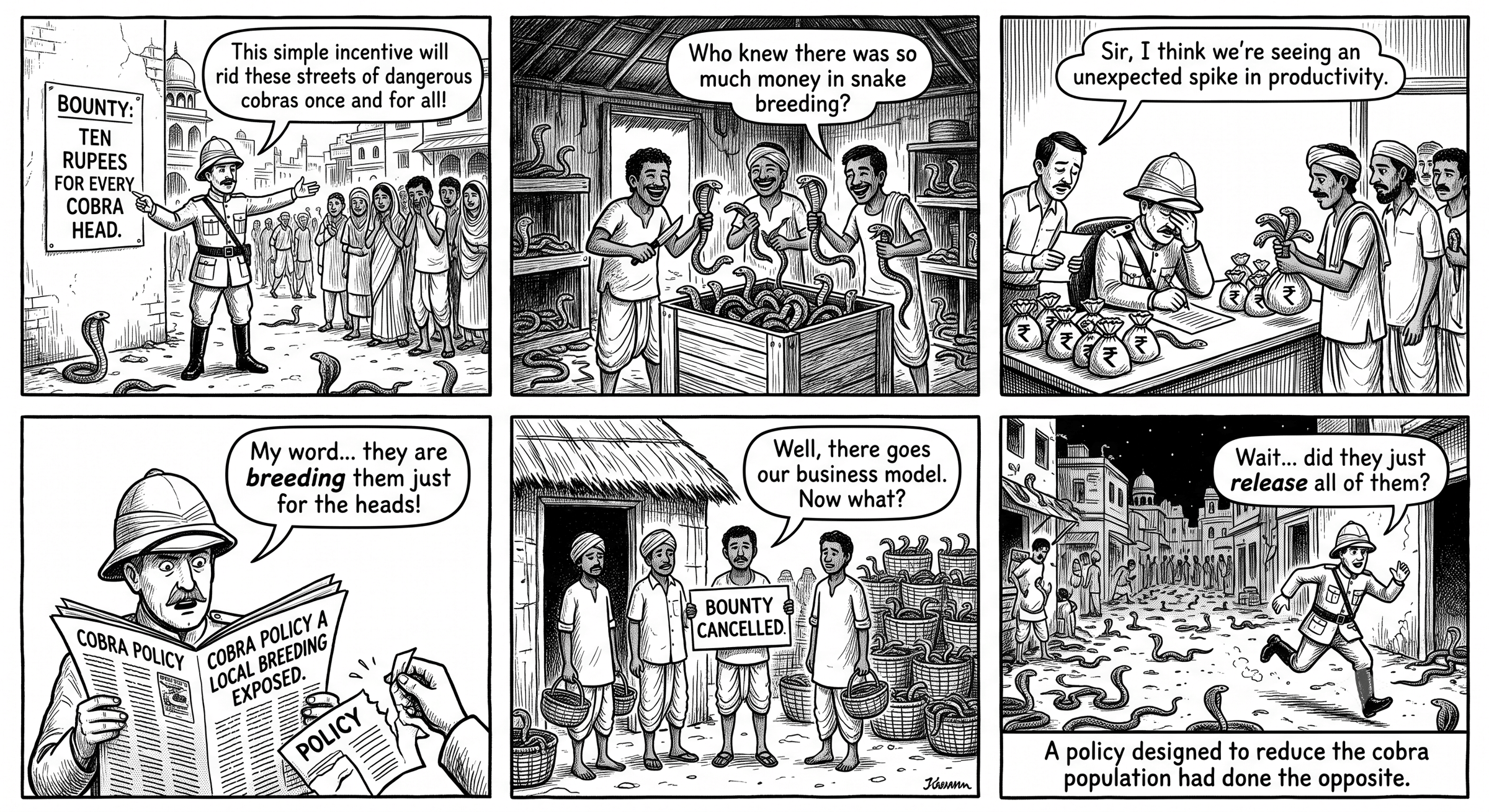
The Cobra Effect is an example of Goodhart’s Law, which says that when a measure becomes a target, it ceases to be a good measure.

In other words, if a measure of performance becomes a stated goal, humans will tend to optimize for it, regardless of any associated consequences.

We often see examples of this in the professional world:

  • Performance targets tied to new account openings result in a lot of fake account openings.
  • Managers with clear % employee turnover goals are found to be engaged in hire-to-fire practices.

In each case, the well-intended measure became a target, people optimized for it, and unintended consequences followed.

The measure ceased to be a good measure.

While most commonly talked about in business, I think the most interesting (and damning) application is found in your life:

How often do you fall victim to the Cobra Effects of life?

The Measures That Own You

In a recent piece, entitled ​The Cult of the Enhanced Self​, my friend and author Derek Thompson wrote about his experience wearing a sleep-tracking device:

"The ring improved my life. But its form of self-improvement often pulls me away from other people. This left me with a nagging question. At what point is it unhealthy for me—for anyone, for all of us—to be this obsessed with health?"

This, it feels, is an all-too-common phenomenon.

You put on the health tracking device. You experience real benefits from the new set of measurements in your life. Maybe you sleep better. Maybe you move more. Maybe you eat healthier. Maybe all of the above.

But you also find yourself opting out of more social activities. Saying no to spontaneous gatherings. Avoiding things you used to love for fear of the impact on your new measurements.

As I often joke with myself when I experience this:

You've got a perfect sleep score, but no friends. Great.

And it's not just health tracking...

I experienced a similar phenomenon when it came to my morning routine.

I used to be fanatical about executing it. Cold plunge. Shower. Perfect coffee. Stretch. Breathing. I loved it. It felt great, but all told, it would be an hour before I got started on the things that the routine was supposed to prepare me to do.

What's more, if I had a lat night event, unexpected commitment, or chaotic bedtime with my toddler son, I’d get pre-stressed—a weird anticipatory anxiety about not nailing the next morning's routine.

The morning routine designed to serve me had started to own me.

The most damning version of this phenomenon occurs with the most common measure in life:

Money.

When money becomes the sole target, unintended consequences abound:

You hit another quarterly target but miss another anniversary dinner. You earn your record bonus but fail to make it to your child's recital. You say yes to every work call but can’t find time to reconnect with an old friend.

You never leave money on the table but don't think twice about leaving your peace of mind there.

You optimize for the one thing but lose sight of everything.

How to Become a Snake Charmer

First off, recognize this isn't some character flaw, lack of discipline, or failure of motivation. It's a normal, abundantly human cognitive flaw.

Scientists refer to it as surrogation: The process or tendency where a measure, metric, or proxy replaces the actual, more complex concept, goal, or target.

Basically, you lose sight of the real thing the measure was meant to represent and start treating the measure as the thing itself.

Snake heads become safer cities. Sleep scores become life improvement. Routine adherence becomes professional growth. Money becomes life success.

So, what do you do about it?

I've found three practices to be helpful:

1. Remind yourself the measure is not the goal.

Whatever you choose to measure in your life, make sure you separate the measure from the goal.

Your sleep score is not the goal. A healthy, thriving life is. Your bank account balance is not the goal. Freedom is.

Create a clear separation of the two. On a blank sheet of paper, write down the measure on the left side with an arrow pointing to the goal on the right side. Place it somewhere so that you'll be forced to see it regularly.

2. Name the unintended consequences upfront.

“All I want to know is where I’m going to die, so I’ll never go there.” - Charlie Munger

What are the potential traps hiding in your pursuit of progress against the measure?

What would be the signs or indications that you were starting to experience those unintended consequences in your life?

On the bottom of the same sheet from the first practice, write them down.

3. Course correct early and often.

As the famous saying goes, no plan has ever survived first contact with the enemy.

Adaptability is the key to life. You don't need to trust in your plan or your intelligence. You need to trust in your ability to adapt on the fly.

Create a simple monthly or quarterly check in.

Are you seeing any of the unintended consequences materializing in your life? If so, how can you gently course correct to avoid them?

The cognitive blindspot is inevitable, but the outcome doesn't have to be.

  1. Separate measure from goal.
  2. Name the unintended consequences.
  3. Course correct when you start to feel them.

You don't have to kill the cobras. You just have to learn to charm them.

The Cobra Effects of Life

Sahil Bloom

Welcome to the 242 new members of the curiosity tribe who have joined us since Wednesday. Join the 57,887 others who are receiving high-signal, curiosity-inducing content every single week.

What’s a Rich Text element?

The rich text element allows you to create and format headings, paragraphs, blockquotes, images, and video all in one place instead of having to add and format them individually. Just double-click and easily create content.

Static and dynamic content editing

A rich text element can be used with static or dynamic content. For static content,

just drop it into any page and begin editing. For dynamic content, add a rich text field to any collection and then connect a rich text element to that field in the settings panel. Voila!

  • mldsa
  • ,l;cd
  • mkclds

How to customize formatting for each rich text

Headings, paragraphs, blockquotes, figures, images, and figure captions can all be styled after a class is added to the rich text element using the "When inside of"

nested selector

system.

Over the weekend, I stumbled across the following ​tweet​:

The video in the tweet, which has been viewed by 20 million people at the time of this writing, is the stuff of childhood (and adult!) nightmares.

Hundreds of venomous snakes on the loose in a village. You can practically see the cringe-inducing Netflix movie already.

But I have to admit, being the nerd that I am, the video sent me down a very different rabbit hole than most others.

I was reminded of an apocryphal story from colonial India:

The British colonists became concerned about the cobra population in Indian cities.

So, they decided to institute a policy that offered a bounty for cobra heads. Anyone who turned in a cobra head would be rewarded with compensation. They thought the incentive would lead people to catch and kill the venomous creatures, thereby reducing the threat.

But the plan backfired…

A group of enterprising individuals spotted a business opportunity: They could breed cobras, chop off their heads, and turn them in to collect the money.

Quickly, the British realized what was happening and ended the policy.

Realizing they had thousands of now-worthless cobras, the breeders simply released them onto the streets, dramatically increasing the population of cobras in the cities.

A policy designed to reduce the cobra population had done the opposite.

The Cobra Effect is an example of Goodhart’s Law, which says that when a measure becomes a target, it ceases to be a good measure.

In other words, if a measure of performance becomes a stated goal, humans will tend to optimize for it, regardless of any associated consequences.

We often see examples of this in the professional world:

  • Performance targets tied to new account openings result in a lot of fake account openings.
  • Managers with clear % employee turnover goals are found to be engaged in hire-to-fire practices.

In each case, the well-intended measure became a target, people optimized for it, and unintended consequences followed.

The measure ceased to be a good measure.

While most commonly talked about in business, I think the most interesting (and damning) application is found in your life:

How often do you fall victim to the Cobra Effects of life?

The Measures That Own You

In a recent piece, entitled ​The Cult of the Enhanced Self​, my friend and author Derek Thompson wrote about his experience wearing a sleep-tracking device:

"The ring improved my life. But its form of self-improvement often pulls me away from other people. This left me with a nagging question. At what point is it unhealthy for me—for anyone, for all of us—to be this obsessed with health?"

This, it feels, is an all-too-common phenomenon.

You put on the health tracking device. You experience real benefits from the new set of measurements in your life. Maybe you sleep better. Maybe you move more. Maybe you eat healthier. Maybe all of the above.

But you also find yourself opting out of more social activities. Saying no to spontaneous gatherings. Avoiding things you used to love for fear of the impact on your new measurements.

As I often joke with myself when I experience this:

You've got a perfect sleep score, but no friends. Great.

And it's not just health tracking...

I experienced a similar phenomenon when it came to my morning routine.

I used to be fanatical about executing it. Cold plunge. Shower. Perfect coffee. Stretch. Breathing. I loved it. It felt great, but all told, it would be an hour before I got started on the things that the routine was supposed to prepare me to do.

What's more, if I had a lat night event, unexpected commitment, or chaotic bedtime with my toddler son, I’d get pre-stressed—a weird anticipatory anxiety about not nailing the next morning's routine.

The morning routine designed to serve me had started to own me.

The most damning version of this phenomenon occurs with the most common measure in life:

Money.

When money becomes the sole target, unintended consequences abound:

You hit another quarterly target but miss another anniversary dinner. You earn your record bonus but fail to make it to your child's recital. You say yes to every work call but can’t find time to reconnect with an old friend.

You never leave money on the table but don't think twice about leaving your peace of mind there.

You optimize for the one thing but lose sight of everything.

How to Become a Snake Charmer

First off, recognize this isn't some character flaw, lack of discipline, or failure of motivation. It's a normal, abundantly human cognitive flaw.

Scientists refer to it as surrogation: The process or tendency where a measure, metric, or proxy replaces the actual, more complex concept, goal, or target.

Basically, you lose sight of the real thing the measure was meant to represent and start treating the measure as the thing itself.

Snake heads become safer cities. Sleep scores become life improvement. Routine adherence becomes professional growth. Money becomes life success.

So, what do you do about it?

I've found three practices to be helpful:

1. Remind yourself the measure is not the goal.

Whatever you choose to measure in your life, make sure you separate the measure from the goal.

Your sleep score is not the goal. A healthy, thriving life is. Your bank account balance is not the goal. Freedom is.

Create a clear separation of the two. On a blank sheet of paper, write down the measure on the left side with an arrow pointing to the goal on the right side. Place it somewhere so that you'll be forced to see it regularly.

2. Name the unintended consequences upfront.

“All I want to know is where I’m going to die, so I’ll never go there.” - Charlie Munger

What are the potential traps hiding in your pursuit of progress against the measure?

What would be the signs or indications that you were starting to experience those unintended consequences in your life?

On the bottom of the same sheet from the first practice, write them down.

3. Course correct early and often.

As the famous saying goes, no plan has ever survived first contact with the enemy.

Adaptability is the key to life. You don't need to trust in your plan or your intelligence. You need to trust in your ability to adapt on the fly.

Create a simple monthly or quarterly check in.

Are you seeing any of the unintended consequences materializing in your life? If so, how can you gently course correct to avoid them?

The cognitive blindspot is inevitable, but the outcome doesn't have to be.

  1. Separate measure from goal.
  2. Name the unintended consequences.
  3. Course correct when you start to feel them.

You don't have to kill the cobras. You just have to learn to charm them.