Click Here
Cart

Order the instant New York Times bestseller: The 5 Types of Wealth

Order My NYT Bestselling Book

The 2 Types of Knowledge: Real vs. Surface

Sahil Bloom

Welcome to the 242 new members of the curiosity tribe who have joined us since Wednesday. Join the 57,887 others who are receiving high-signal, curiosity-inducing content every single week.

What’s a Rich Text element?

The rich text element allows you to create and format headings, paragraphs, blockquotes, images, and video all in one place instead of having to add and format them individually. Just double-click and easily create content.

Static and dynamic content editing

A rich text element can be used with static or dynamic content. For static content,

just drop it into any page and begin editing. For dynamic content, add a rich text field to any collection and then connect a rich text element to that field in the settings panel. Voila!

  • mldsa
  • ,l;cd
  • mkclds

How to customize formatting for each rich text

Headings, paragraphs, blockquotes, figures, images, and figure captions can all be styled after a class is added to the rich text element using the "When inside of"

nested selector

system.

In 1918, German theoretical physicist Max Planck won the Nobel Prize for his discovery of energy quanta.

After winning the prize, he went on a tour, giving lectures at universities and institutions around the country on his findings.

There’s an apocryphal story from that tour that I first came across while reading the transcript of Charlie Munger’s 2007 commencement speech at USC Law School.

Max Planck’s chauffeur, after having heard Planck practice and deliver the talk so many times, had the entire thing memorized.

He jokingly asked Planck if he could deliver it at the final lecture.

Surprisingly, the physicist agreed.

The chauffeur put on a jacket and tie and proceeded to deliver a perfect lecture, word for word, just as Max Planck would have done. But at the end of the talk, a simple follow-up question from the audience left him completely stumped.

Quick on his feet, the chauffeur replied:

"That question is so easy, I’ll let my chauffeur answer it," and pointed to a smiling Planck, who was standing in a chauffeur hat in the back of the crowd.

While the story is most certainly dramatized, it brings to life an important lesson with real implications for the current cultural moment.

There are two types of knowledge:

  1. Real Knowledge
  2. Surface Knowledge

Real Knowledge has depth. It’s flexible and dynamic. It can be leveraged in different ways, because the topic is truly understood, not just memorized. It’s only acquired through hours and hours of working on a specific craft.

Surface Knowledge is the opposite. It’s rigid and fixed. It may look the part to pass muster at a cocktail party or ace an easy exam, but it fails when put under any degree of scrutiny.

There’s a big difference between truly knowing something and just sounding smart talking about it.

And in the current moment, it’s never been easier to do so…

I’ve been thinking a lot about the use of artificial intelligence and its impact on human intelligence.

In a widely cited (though not peer reviewed) ​MIT study​, researchers found that the use of AI tools for writing tasks negatively impacted cognitive function.
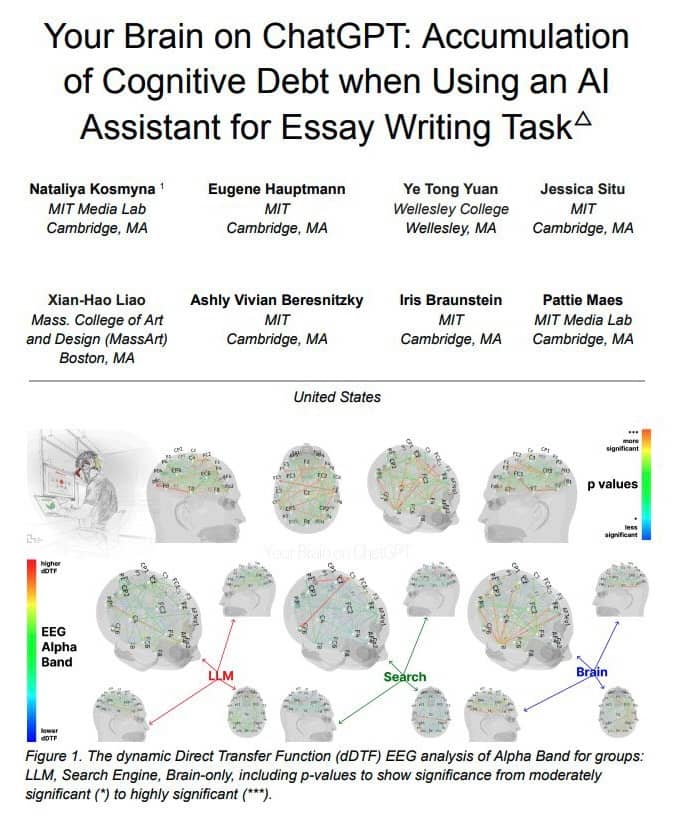
While the sample size and lack of peer review may not offer definitive proof of anything, my suspicion is that this is the first of many that will show something in a similar vein.

In a broad sense, I think most personal AI use cases are about outsourcing something to AI. You previously had to use your brain for that thing, but now you can press a button and have the AI do that thing for you.

It’s important to remember: What you outsource will atrophy.

Hire a personal chef, you’ll probably lose some of your cooking skills. Hire a money manager, you’ll probably be less in tune with your finances. Hire an analyst, you’ll probably become less proficient with analysis.

That’s ok when it’s about outsourcing specific things that are lower leverage. But what about when the outsourcing slowly extends into more generalized thinking?

My concern is that as we outsource more and more of our general thinking to these models, all Real Knowledge will atrophy. We will become defined by Surface Knowledge.

A species of breadth, but no depth.

And the social incentives for breadth are very real:

You’re encouraged to have an opinion on everything. We’ve collectively frowned upon those who say “I don’t know” or “I don’t know enough to have a perspective on that” in any social setting.

A lot of problems in the world are a second-order effect of people with Surface Knowledge masquerading as people with Real Knowledge:

  • Policymakers with a flimsy understanding of the underlying issues they build campaigns around.
  • Financial pundits who don’t seem to understand historical precedents.
  • Executives who can recite the strategy on a quarterly call but can’t explain the mechanics of how it’ll actually work.

But it’s not all doom and gloom for our future.

In a ​1990 interview​, Steve Jobs offered a poetic description of the computer:

I think one of the things that really separates us from the high primates is that we’re tool builders. I read a study that measured the efficiency of locomotion for various species on the planet.

The condor used the least energy to move a kilometer. And, humans came in with a rather unimpressive showing, about a third of the way down the list…But, then somebody at Scientific American had the insight to test the efficiency of locomotion for a man on a bicycle. And, a man on a bicycle, a human on a bicycle, blew the condor away, completely off the top of the charts.

And that’s what a computer is to me. What a computer is to me is it’s the most remarkable tool that we’ve ever come up with,
and it’s the equivalent of a bicycle for our minds.

More recently, Naval Ravikant ​built upon this analogy​:

Steve Jobs famously said that a computer is a bicycle for the mind. It lets you travel much faster than walking, certainly in terms of efficiency. But it takes the legs to turn the pedals in the first place.

And so now maybe [AI is] a motorcycle for the mind
, to stretch the analogy, but you still need someone to ride it, to drive it, to direct it, to hit the accelerator, and to hit the brake.

So, perhaps our “legs” will atrophy with this new motorcycle in our lives. Perhaps there are certain areas where Surface Knowledge will reign supreme.

But with these new technologies, there’s also a corresponding potential:

With less energy needed for the legs, where might we redeploy it to go faster, further, and deeper?

That’s the fundamental question facing each one of us today. And really, it’s a choice:

Sure, you can choose to outsource every element of your life. Become a Surface Knowledge being and slowly resemble something out of a dystopian future like Wall-E. You can become the chauffeur, confidently reciting the lecture but unable to answer a basic question.

Or, you can choose a different way. You can outsource some arenas in order to go deeper in others. You can ride that motorcycle at 100mph into your future. You can become Max Planck, smiling in the back of the room, ready to take on the world.

The choice is yours. Choose wisely.

The 2 Types of Knowledge: Real vs. Surface

Sahil Bloom

Welcome to the 242 new members of the curiosity tribe who have joined us since Wednesday. Join the 57,887 others who are receiving high-signal, curiosity-inducing content every single week.

What’s a Rich Text element?

The rich text element allows you to create and format headings, paragraphs, blockquotes, images, and video all in one place instead of having to add and format them individually. Just double-click and easily create content.

Static and dynamic content editing

A rich text element can be used with static or dynamic content. For static content,

just drop it into any page and begin editing. For dynamic content, add a rich text field to any collection and then connect a rich text element to that field in the settings panel. Voila!

  • mldsa
  • ,l;cd
  • mkclds

How to customize formatting for each rich text

Headings, paragraphs, blockquotes, figures, images, and figure captions can all be styled after a class is added to the rich text element using the "When inside of"

nested selector

system.

In 1918, German theoretical physicist Max Planck won the Nobel Prize for his discovery of energy quanta.

After winning the prize, he went on a tour, giving lectures at universities and institutions around the country on his findings.

There’s an apocryphal story from that tour that I first came across while reading the transcript of Charlie Munger’s 2007 commencement speech at USC Law School.

Max Planck’s chauffeur, after having heard Planck practice and deliver the talk so many times, had the entire thing memorized.

He jokingly asked Planck if he could deliver it at the final lecture.

Surprisingly, the physicist agreed.

The chauffeur put on a jacket and tie and proceeded to deliver a perfect lecture, word for word, just as Max Planck would have done. But at the end of the talk, a simple follow-up question from the audience left him completely stumped.

Quick on his feet, the chauffeur replied:

"That question is so easy, I’ll let my chauffeur answer it," and pointed to a smiling Planck, who was standing in a chauffeur hat in the back of the crowd.

While the story is most certainly dramatized, it brings to life an important lesson with real implications for the current cultural moment.

There are two types of knowledge:

  1. Real Knowledge
  2. Surface Knowledge

Real Knowledge has depth. It’s flexible and dynamic. It can be leveraged in different ways, because the topic is truly understood, not just memorized. It’s only acquired through hours and hours of working on a specific craft.

Surface Knowledge is the opposite. It’s rigid and fixed. It may look the part to pass muster at a cocktail party or ace an easy exam, but it fails when put under any degree of scrutiny.

There’s a big difference between truly knowing something and just sounding smart talking about it.

And in the current moment, it’s never been easier to do so…

I’ve been thinking a lot about the use of artificial intelligence and its impact on human intelligence.

In a widely cited (though not peer reviewed) ​MIT study​, researchers found that the use of AI tools for writing tasks negatively impacted cognitive function.

While the sample size and lack of peer review may not offer definitive proof of anything, my suspicion is that this is the first of many that will show something in a similar vein.

In a broad sense, I think most personal AI use cases are about outsourcing something to AI. You previously had to use your brain for that thing, but now you can press a button and have the AI do that thing for you.

It’s important to remember: What you outsource will atrophy.

Hire a personal chef, you’ll probably lose some of your cooking skills. Hire a money manager, you’ll probably be less in tune with your finances. Hire an analyst, you’ll probably become less proficient with analysis.

That’s ok when it’s about outsourcing specific things that are lower leverage. But what about when the outsourcing slowly extends into more generalized thinking?

My concern is that as we outsource more and more of our general thinking to these models, all Real Knowledge will atrophy. We will become defined by Surface Knowledge.

A species of breadth, but no depth.

And the social incentives for breadth are very real:

You’re encouraged to have an opinion on everything. We’ve collectively frowned upon those who say “I don’t know” or “I don’t know enough to have a perspective on that” in any social setting.

A lot of problems in the world are a second-order effect of people with Surface Knowledge masquerading as people with Real Knowledge:

  • Policymakers with a flimsy understanding of the underlying issues they build campaigns around.
  • Financial pundits who don’t seem to understand historical precedents.
  • Executives who can recite the strategy on a quarterly call but can’t explain the mechanics of how it’ll actually work.

But it’s not all doom and gloom for our future.

In a ​1990 interview​, Steve Jobs offered a poetic description of the computer:

I think one of the things that really separates us from the high primates is that we’re tool builders. I read a study that measured the efficiency of locomotion for various species on the planet.

The condor used the least energy to move a kilometer. And, humans came in with a rather unimpressive showing, about a third of the way down the list…But, then somebody at Scientific American had the insight to test the efficiency of locomotion for a man on a bicycle. And, a man on a bicycle, a human on a bicycle, blew the condor away, completely off the top of the charts.

And that’s what a computer is to me. What a computer is to me is it’s the most remarkable tool that we’ve ever come up with,
and it’s the equivalent of a bicycle for our minds.

More recently, Naval Ravikant ​built upon this analogy​:

Steve Jobs famously said that a computer is a bicycle for the mind. It lets you travel much faster than walking, certainly in terms of efficiency. But it takes the legs to turn the pedals in the first place.

And so now maybe [AI is] a motorcycle for the mind
, to stretch the analogy, but you still need someone to ride it, to drive it, to direct it, to hit the accelerator, and to hit the brake.

So, perhaps our “legs” will atrophy with this new motorcycle in our lives. Perhaps there are certain areas where Surface Knowledge will reign supreme.

But with these new technologies, there’s also a corresponding potential:

With less energy needed for the legs, where might we redeploy it to go faster, further, and deeper?

That’s the fundamental question facing each one of us today. And really, it’s a choice:

Sure, you can choose to outsource every element of your life. Become a Surface Knowledge being and slowly resemble something out of a dystopian future like Wall-E. You can become the chauffeur, confidently reciting the lecture but unable to answer a basic question.

Or, you can choose a different way. You can outsource some arenas in order to go deeper in others. You can ride that motorcycle at 100mph into your future. You can become Max Planck, smiling in the back of the room, ready to take on the world.

The choice is yours. Choose wisely.