


How Old Will You Be If You Don’t?

Today at a Glance
What’s a Rich Text element?
The rich text element allows you to create and format headings, paragraphs, blockquotes, images, and video all in one place instead of having to add and format them individually. Just double-click and easily create content.
Static and dynamic content editing
A rich text element can be used with static or dynamic content. For static content, just drop it into any page and begin editing. For dynamic content, add a rich text field to any collection and then connect a rich text element to that field in the settings panel. !
- ml;xsml;xa
- koxsaml;xsml;xsa
- mklxsaml;xsa
How to customize formatting for each rich text
Headings, paragraphs, blockquotes, figures, images, and figure captions can all be styled after a class is added to the rich text element using the "When inside of" nested selector system.
Last week, I wrote a piece about reinvention. Specifically, the myth of too late and how to reinvent your life at any age or life stage.
It clearly struck a chord.
I received thousands of replies in the days following the piece. One reader reply referenced a two-decade-old newspaper advice column segment that had resonated on the subject.
Me being me, I decided to try to find the column. After all, if something was still etched into my reader's memory 20+ years later, it must have been good.
I did, and it was even better than advertised:
January 19, 2000
Dear Abby:
I am a 36-year-old college dropout whose lifelong ambition was to be a physician. I have a very good job selling pharmaceutical supplies, but my heart is still in the practice of medicine. I do volunteer work at the local hospital on my time off, and people tell me I would have made a wonderful doctor.
If I go back to college and get my degree, then go to medical school, do my internship and finally get into the actual practice of medicine, it will take me seven years! But, Abby, in seven years I will be 43 years old. What do you think?
- Unfulfilled in Philly
Dear Unfulfilled:
And how old will you be in seven years if you don't go to medical school?
Let that one sink in for a moment.
When I read it, I flashed back to every single version of “it’s too late” that I’ve ever told myself. Every single story about being off track, behind, or lost.
I flashed back to my late-20s, feeling like a failure when I saw people posting about their startup’s funding round, their most recent promotion, or their Forbes 30 Under 30 accolade.
I flashed back to all of the times I had longed for an external stamp of approval. For someone to come tap me in. Tell me I was impressive. On track. Worthy.
But here’s what it took me years to understand:
The timeline in my head was my own creation. Entirely invented. An abstraction of reality so far removed from the real thing that it no longer bore any resemblance to the original.
That timeline forms from a young age. We look out at the world and use what we observe to sketch out a map of how our life is supposed to go. Social media highlight reels tell us how we stack up. What we should be doing. By when. And what we can’t possibly do now.
It’s a form of inheritance. Not one we choose, but one we all get.
So, we tie ourselves in knots, just like Unfulfilled in Philly. We know what we really want, but we’re too afraid to go all in. Because to go all in is to expose yourself to real failure. To be completely naked.
But the harsh truth that Abby so elegantly highlighted is an important one:
Time is unforgiving. It doesn’t care about you. It’s moving with or without you. Whether you choose to act…or not. Whether you live the way you want…or not. Time is just going to pass.
And over time, it’s the things we don’t do that will haunt us the most.
This is more than just conjecture. In a seminal 1994 study, Cornell University psychologists Thomas Gilovich and Victoria Medvec found that there was a clear, systematic time course to the experience of regret.
We regret action in the short-term, but inaction in the long-term—and long-term regrets were significantly more powerful and enduring.
So, consider this a call to action. It might be one for myself just as much as it is for any of you out there reading it today.
How often do we all sit around waiting for someone else to come tap us into our own life? To give us permission to go and do the thing we want to do?
Waiting for our own Dear Abby reply to tell us it’s ok. We’re not too late. We’re right on time.
The real lesson here is recognizing that you don’t need any of that. You don’t need this piece. You don’t need Dear Abby.
You get to tap yourself in. You get to choose.
My dear friend and team member Blake Burge captured this well in a recent viral X post:
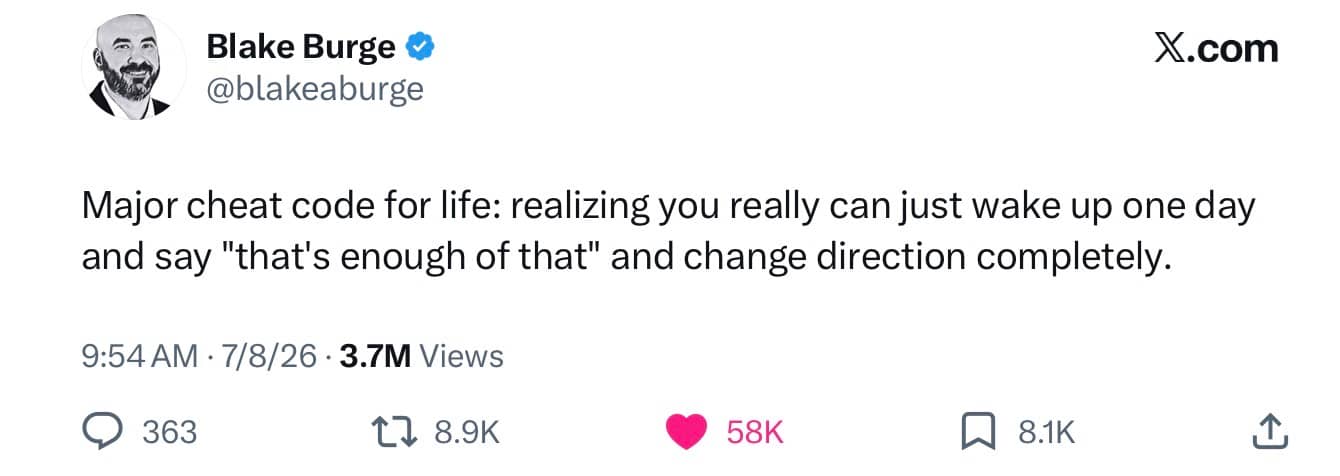
You're not late. You're not early. You're exactly where your life has led you to be. And you get to decide where you go from here.
So, that thing you want to do:
How old will you be in ten years if you don’t do it?


