Click Here
Cart

Order the instant New York Times bestseller: The 5 Types of Wealth

Order My NYT Bestselling Book

The Zipper Test: How to Stop Fooling Yourself

Sahil Bloom

Welcome to the 242 new members of the curiosity tribe who have joined us since Wednesday. Join the 57,887 others who are receiving high-signal, curiosity-inducing content every single week.

What’s a Rich Text element?

The rich text element allows you to create and format headings, paragraphs, blockquotes, images, and video all in one place instead of having to add and format them individually. Just double-click and easily create content.

Static and dynamic content editing

A rich text element can be used with static or dynamic content. For static content,

just drop it into any page and begin editing. For dynamic content, add a rich text field to any collection and then connect a rich text element to that field in the settings panel. Voila!

  • mldsa
  • ,l;cd
  • mkclds

How to customize formatting for each rich text

Headings, paragraphs, blockquotes, figures, images, and figure captions can all be styled after a class is added to the rich text element using the "When inside of"

nested selector

system.

My son just turned four. One of the things I love most about the age is the unbridled curiosity with which he explores the world.

He's deep in the classic "why" phase, taking me down explanatory rabbit holes that go long past my point of comfort.

But one of the most interesting prompts he asked recently was this one:

"Tell me all about zippers."

On any given day, zipper is replaced by some basic thing that we interact with. It might be tell me all about our car, or trees, or cooking pans, or the microwave.

I have a rule that I always engage with him on these little curiosity quests, even if they come at a bad time.

In doing so, I've realized something:

I know very little about how the most basic things around me actually work.

I start confidently, but my ability to answer "tell me all about [X]" generally ends after a few seconds. I quickly reach the outer bounds of my understanding and am forced, hat in hand, to consult with the internet to go deeper.

As it turns out, there's real science behind this.

In 2002, Yale researchers Leonid Rozenblit and Frank Keil conducted ​a series of studies​ in which they asked a group of Yale undergraduate students to rate their understanding of how everyday devices work on a scale of 1-7 (with 1 being low and 7 being high).

The items were things like zippers, flush toilets, sewing machines, bicycle locks, and piano keys.

Each participant was then asked to write out their complete understanding of the workings of the device.

After writing out their explanation, they were asked to re-rate their understanding of the items.

The researchers found that confidence consistently dropped after people tried to write out their explanation of the item. A lot of 7s turned into 2s.

In other words, people thought they knew a lot about the workings of these devices, but when confronted with their lack of knowledge by the written explanation, they had to adjust their inflated sense of understanding.

Quoting the authors:

"People feel they understand complex phenomena with far greater precision, coherence, and depth than they really do; they are subject to an illusion—an illusion of explanatory depth."

Notably, the effect was more pronounced for explanatory knowledge (how and why things work) than simple facts, and it was strongest for things that were visible and ever-present.

The Illusion of Explanatory Depth says that we are overconfident in our understanding of the most common things that exist all around us.

But I think that illusion applies well beyond the confines of household items...

I've observed this phenomenon in my own interactions with highly ambitious, successful people.

I'll often ask what motivates them, why they do the things they do, or how they chose their current pursuits or path.

The first reply is typically a general, surface level one—or a PR-ified version that would sound polished in a news article. Something basic about money, impact, or the like.

So, I'll dig deeper, asking for more clarity. And that's where it gets uncomfortable.

This recently happened with a new acquaintance, who told me his motivation was to make $100 million. It went something like this:

  • Me: That's awesome. Big goal! Why?
  • Him: What do you mean, why?
  • Me: Well, like why $100 million? What does that mean? Why that number? What will that unlock for you? What does that create or signify for you?

I saw him start to shift in his seat. He looked around. Cleared his throat. Glanced at his phone. Took a sip of his coffee.

It was like the visible manifestation of a confidence score adjusting from 7 to 2.

He had certainly never been asked for that level of depth on his own motivations—but perhaps more importantly, he had never asked himself for it.

How much do we really understand about the most basic motivations, structures, and decisions that control our everyday actions, behaviors, and life path?

Without confronting this internal Illusion of Explanatory Depth, you leave yourself exposed to a life by default. A life where all of your motivations and actions are subtly adopted through a sort of cultural and environmental osmosis.

You may climb one mountain for 40 years, only to reach the top and realize you never wanted to be on it in the first place.

The problem is that you're so close to your own life that it paradoxically becomes the easiest life to misunderstand. To glaze over. To assume.

I often come back to the pithy quote from famed physicist Richard Feynman:

"The first principle is that you must not fool yourself and you are the easiest person to fool."

Don't fool yourself into assuming that you're on the right path, that you understand the nature of your motivations and goals, simply because of your familiarity with them.

I might call it the Zipper Test:

Do you actually understand how the zipper works? Or are you just fooling yourself into thinking you do?

If my 4-year-old son asked me to tell him all about my motivations and life, would I be able to confidently answer? Or would I find myself squirming at the inevitable "Why?" he would follow it with?

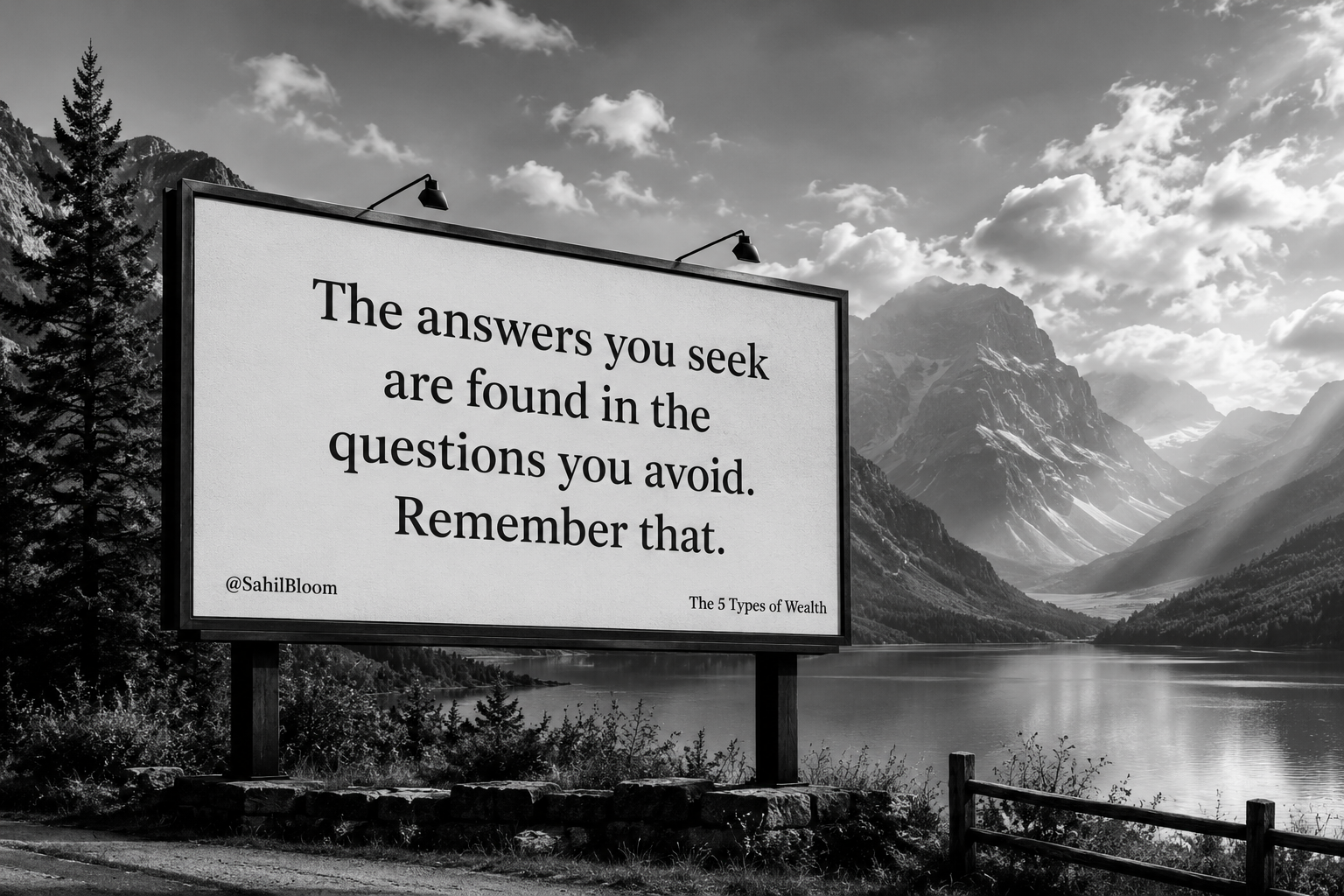
The answers you seek are found in the questions you avoid. Remember that.
The Zipper Test: How to Stop Fooling Yourself

Sahil Bloom

Welcome to the 242 new members of the curiosity tribe who have joined us since Wednesday. Join the 57,887 others who are receiving high-signal, curiosity-inducing content every single week.

What’s a Rich Text element?

The rich text element allows you to create and format headings, paragraphs, blockquotes, images, and video all in one place instead of having to add and format them individually. Just double-click and easily create content.

Static and dynamic content editing

A rich text element can be used with static or dynamic content. For static content,

just drop it into any page and begin editing. For dynamic content, add a rich text field to any collection and then connect a rich text element to that field in the settings panel. Voila!

  • mldsa
  • ,l;cd
  • mkclds

How to customize formatting for each rich text

Headings, paragraphs, blockquotes, figures, images, and figure captions can all be styled after a class is added to the rich text element using the "When inside of"

nested selector

system.

My son just turned four. One of the things I love most about the age is the unbridled curiosity with which he explores the world.

He's deep in the classic "why" phase, taking me down explanatory rabbit holes that go long past my point of comfort.

But one of the most interesting prompts he asked recently was this one:

"Tell me all about zippers."

On any given day, zipper is replaced by some basic thing that we interact with. It might be tell me all about our car, or trees, or cooking pans, or the microwave.

I have a rule that I always engage with him on these little curiosity quests, even if they come at a bad time.

In doing so, I've realized something:

I know very little about how the most basic things around me actually work.

I start confidently, but my ability to answer "tell me all about [X]" generally ends after a few seconds. I quickly reach the outer bounds of my understanding and am forced, hat in hand, to consult with the internet to go deeper.

As it turns out, there's real science behind this.

In 2002, Yale researchers Leonid Rozenblit and Frank Keil conducted ​a series of studies​ in which they asked a group of Yale undergraduate students to rate their understanding of how everyday devices work on a scale of 1-7 (with 1 being low and 7 being high).

The items were things like zippers, flush toilets, sewing machines, bicycle locks, and piano keys.

Each participant was then asked to write out their complete understanding of the workings of the device.

After writing out their explanation, they were asked to re-rate their understanding of the items.

The researchers found that confidence consistently dropped after people tried to write out their explanation of the item. A lot of 7s turned into 2s.

In other words, people thought they knew a lot about the workings of these devices, but when confronted with their lack of knowledge by the written explanation, they had to adjust their inflated sense of understanding.

Quoting the authors:

"People feel they understand complex phenomena with far greater precision, coherence, and depth than they really do; they are subject to an illusion—an illusion of explanatory depth."

Notably, the effect was more pronounced for explanatory knowledge (how and why things work) than simple facts, and it was strongest for things that were visible and ever-present.

The Illusion of Explanatory Depth says that we are overconfident in our understanding of the most common things that exist all around us.

But I think that illusion applies well beyond the confines of household items...

I've observed this phenomenon in my own interactions with highly ambitious, successful people.

I'll often ask what motivates them, why they do the things they do, or how they chose their current pursuits or path.

The first reply is typically a general, surface level one—or a PR-ified version that would sound polished in a news article. Something basic about money, impact, or the like.

So, I'll dig deeper, asking for more clarity. And that's where it gets uncomfortable.

This recently happened with a new acquaintance, who told me his motivation was to make $100 million. It went something like this:

  • Me: That's awesome. Big goal! Why?
  • Him: What do you mean, why?
  • Me: Well, like why $100 million? What does that mean? Why that number? What will that unlock for you? What does that create or signify for you?

I saw him start to shift in his seat. He looked around. Cleared his throat. Glanced at his phone. Took a sip of his coffee.

It was like the visible manifestation of a confidence score adjusting from 7 to 2.

He had certainly never been asked for that level of depth on his own motivations—but perhaps more importantly, he had never asked himself for it.

How much do we really understand about the most basic motivations, structures, and decisions that control our everyday actions, behaviors, and life path?

Without confronting this internal Illusion of Explanatory Depth, you leave yourself exposed to a life by default. A life where all of your motivations and actions are subtly adopted through a sort of cultural and environmental osmosis.

You may climb one mountain for 40 years, only to reach the top and realize you never wanted to be on it in the first place.

The problem is that you're so close to your own life that it paradoxically becomes the easiest life to misunderstand. To glaze over. To assume.

I often come back to the pithy quote from famed physicist Richard Feynman:

"The first principle is that you must not fool yourself and you are the easiest person to fool."

Don't fool yourself into assuming that you're on the right path, that you understand the nature of your motivations and goals, simply because of your familiarity with them.

I might call it the Zipper Test:

Do you actually understand how the zipper works? Or are you just fooling yourself into thinking you do?

If my 4-year-old son asked me to tell him all about my motivations and life, would I be able to confidently answer? Or would I find myself squirming at the inevitable "Why?" he would follow it with?

The answers you seek are found in the questions you avoid. Remember that.