


A Japanese Ritual to Improve Your Habits

Today at a Glance
What’s a Rich Text element?
The rich text element allows you to create and format headings, paragraphs, blockquotes, images, and video all in one place instead of having to add and format them individually. Just double-click and easily create content.
Static and dynamic content editing
A rich text element can be used with static or dynamic content. For static content, just drop it into any page and begin editing. For dynamic content, add a rich text field to any collection and then connect a rich text element to that field in the settings panel. !
- ml;xsml;xa
- koxsaml;xsml;xsa
- mklxsaml;xsa
How to customize formatting for each rich text
Headings, paragraphs, blockquotes, figures, images, and figure captions can all be styled after a class is added to the rich text element using the "When inside of" nested selector system.
In the early 1900s, an aging Japanese steam train engineer named Yasoichi Hori was growing increasingly concerned about his deteriorating eyesight.
Hori's job relied on his ability to quickly read small track signals at a distance while moving at a high rate of speed. The cab he worked in was at the back of the locomotive, behind a large boiler, which meant that he often had to lean out a side window to catch the signals coming up on the track ahead.
In the small, cramped cab, it was just Hori and his fireman, who was responsible for shoveling coal into the firebox while also keeping an eye on the signals.
Hori's worst fear was missing or misreading a trackside signal, an error that could lead to a catastrophic crash.
Worried that he could no longer trust his eyes, he began doing something odd:
Whenever the train passed a signal, he would call the signal's status out loud. At first, not knowing why Hori was doing it, the fireman replied by calling out confirmation of the signal's status.
It became a simple safety ritual for Yasoichi Hori and his fireman.
As the story goes, the practice was formalized in 1913, written into the Japanese railway manuals as call-and-response.
In the late 1920s, the call-and-response practice got an update when a finger-point was layered in. Now, the engineer was told to physically point at the signal and call out its status, with the cab-mate doing the same in response.
The practice became known as Shisa Kanko. Pointing and calling.
If you travel to Japan today, you'll see the century-old practice still in effect. Train conductors routinely point at signals and shout their status into the air.
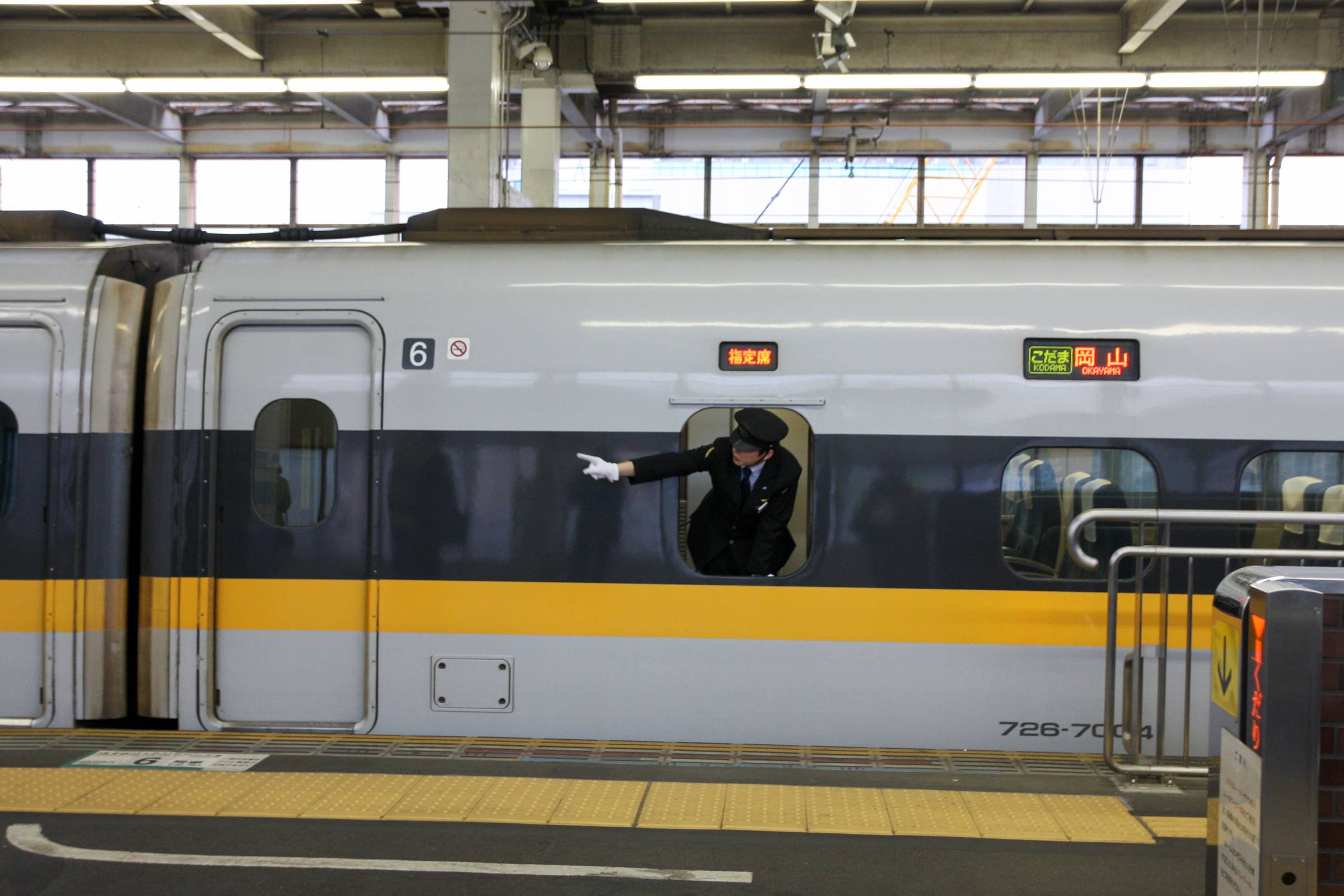
The guiding principle is that the practice offers a simple way to shift the signal-reading action from automatic to deliberate, thereby dramatically reducing the risk of error.
As it turns out, there's real science to substantiate it:
In 1994, the Japan Railway Technical Research Institute conducted a study in which workers were asked to complete a simple task. At first, no additional steps were taken to prevent errors, and the workers made 2.38 errors per 100 actions executed.
Next, they added a step to either physically point at the task or call out the task. The error rate came down.
But the most striking error rate reduction came from the addition of both pointing and calling. The group made just 0.38 mistakes per 100 actions executed.
An 84% reduction vs. the baseline.
In a 2013 peer-reviewed study, researchers found that pointing and calling boosts the supervisory attentional system. Pointing orients visual attention to the exact target. Calling drives selective retrieval of the appropriate rule or information from working memory.
In simple terms, it forces a deliberate control system to turn on and engage, which can be really helpful in scenarios where an automatic action may be dangerous (or where it leaves something to be desired).
And that last bit is where this Japanese ritual enters the scene in your life:
There are times when your autopilot fails you. The unconscious, default habits and behaviors that you run on aren't serving you. They aren't moving you in the direction of the life you want.
But fortunately, we can use the same idea of Shisa Kanko, pointing and calling, to change all of that.
The application runs in two distinct directions:
1. The Negative
This is about addressing that bad habit that you want to break.
The reason most bad habits perpetuate is because they become automatic. You don't actively seek to harm your life. You just quietly slip into it, day by day. Tiny actions that happen mostly out of the spotlight of your mind.
I've found that pointing and calling is a highly effective means of breaking those patterns of behavior.
The next time you're about to grab that sugar-laden snack you said you wouldn't eat. Or sit on the couch instead of going for that walk. Or scroll your phone even though it makes you feel miserable. Point at it and call it out.
- Point at the snack and say "I'm not going to eat that snack. It's not helping me feel my best."
- Point at the couch and say "I'm not going to sit there and skip that walk. I know I'll feel great if I get outside."
- Point at the phone and say "I'm not going to scroll Instagram for an hour. It makes me feel like I'm not enough."
You may not win out every single time, but the act will force the bad habit into your conscious mind and make you significantly less likely to engage in the behavior that doesn't serve you.
2. The Positive
This is about building that good habit that you want to create.
It can be difficult to build a new good habit if it's not a part of your standard practices. And even more so, if you don't internalize the feeling of momentum from doing it. If you don't give yourself credit. Feel the sensation of a win.
Again, I've found that pointing and calling is an effective means of building those new patterns of behavior.
- Point at the running shoes and say "I'm going to put those on and just get out the door. I'll feel great if I start."
- Point at the groceries in the fridge and say "I'm going to make a healthy meal instead of ordering takeout. I know I'll feel great after eating it."
- Point at a lockbox and say "I'm going to put my phone in that for the next two hours. It makes me more present with my family."
Connect with the positive behaviors. Remind yourself how it feels after you do it. Give yourself that win before you start and you're more likely to get going.
I know it may seem a bit silly, pointing and calling these things out loud, but trust me, it works.
Yasoichi Hori started calling out train signals because he couldn't trust his eyes. His autopilot was failing.
If your autopilot is leaving something to be desired, it needs an upgrade.
Point and call. Shisa Kanko.


