I Think I Need to Talk About Failure

Today at a Glance
What’s a Rich Text element?
The rich text element allows you to create and format headings, paragraphs, blockquotes, images, and video all in one place instead of having to add and format them individually. Just double-click and easily create content.
Static and dynamic content editing
A rich text element can be used with static or dynamic content. For static content, just drop it into any page and begin editing. For dynamic content, add a rich text field to any collection and then connect a rich text element to that field in the settings panel. !
- ml;xsml;xa
- koxsaml;xsml;xsa
- mklxsaml;xsa
How to customize formatting for each rich text
Headings, paragraphs, blockquotes, figures, images, and figure captions can all be styled after a class is added to the rich text element using the "When inside of" nested selector system.
Today’s newsletter has a very different shape than the one I had planned.
Last Sunday, I was scheduled to run a marathon with a goal of completing the race in 2:49:59. This equates to a 6:28 pace per mile (or 4:00 per kilometer) and would have been a three minute personal best for me in the distance.
I trained all summer for the race, building up to 70+ mile weeks in addition to my lifting routines. I tapered for two weeks. I carb loaded. I meticulously prepared for every detail.
And honestly, I was certain I’d do it. It was well within my fitness level given my training runs.
In fact, I was so certain that I’d already planned out my newsletter for this week:
9 Lessons From My 2:49 Marathon (That Have Nothing To Do With Running)
But…I failed.
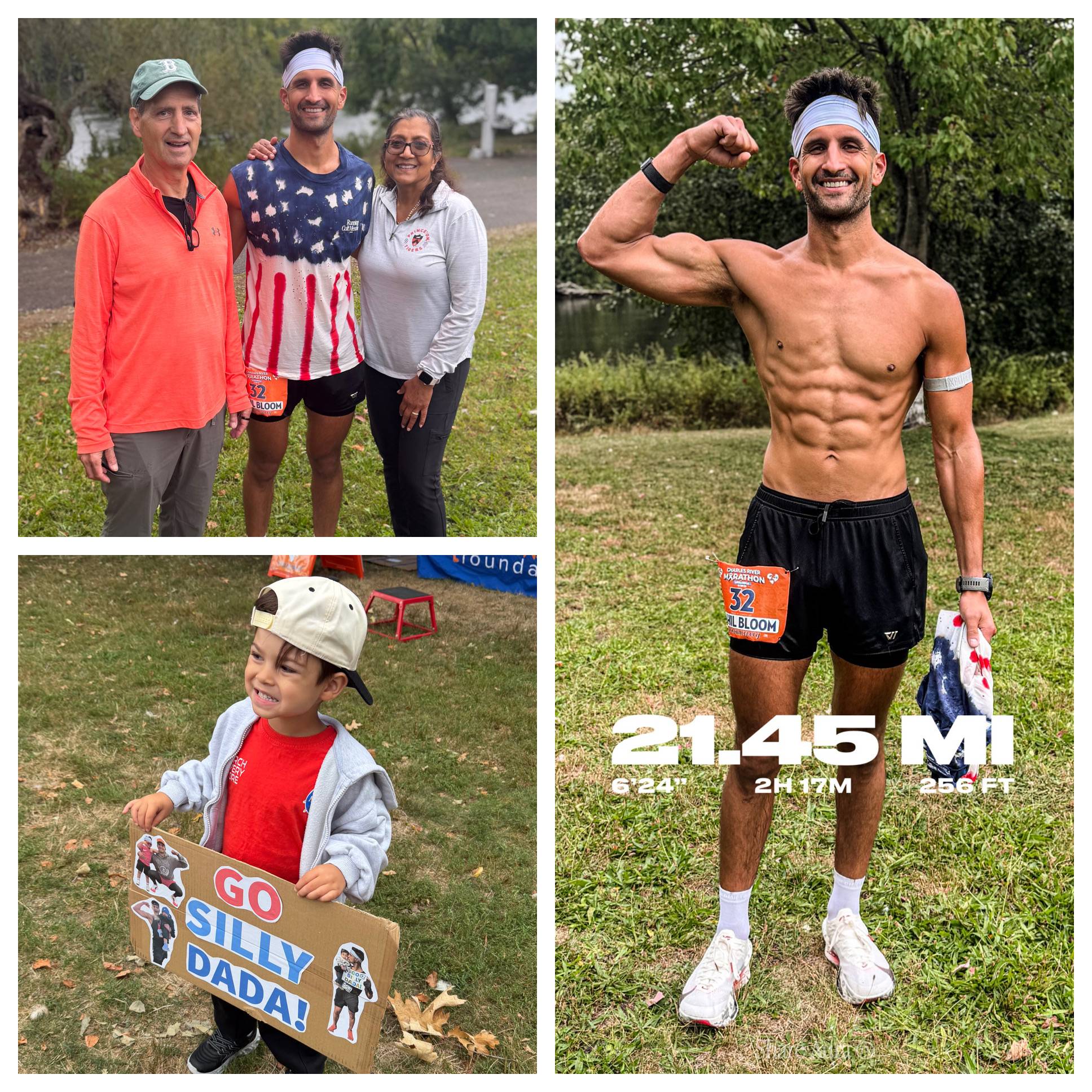
After 21.45 miles at a 6:24 average pace, I stopped and walked off the course. I didn’t finish. DNF.
That’s not something you read in newsletters or see on social media every day. It’s all about wins. Successes. Achievements.
But in the interest of transparently sharing the real journey, not just the highlights, today, I think I need to talk about failure.
No matter what goal you’re chasing in life, you should read this…
First off, let’s start with the failure itself.
What happened?
There’s a funny saying in marathon running that the marathon is really a 20 mile warmup and a 6.2 mile race. As with all such sayings, it has a seed of truth.
But it’s not that the last 6.2 miles are any different than the first 20. It’s that the last 6.2 miles reveal a combination of (1) your preparedness and (2) the execution of the first 20 miles.
I was very prepared. All of my training had been meticulous. I had run all the paces, speeds, and distances required. I had run a 2:56 marathon around a track. I had run 24 miles at my marathon pace. I was ready.
And as for execution, there are really three components:
- Pacing: Running smart, not going too fast early in the race.
- Nutrition: Consuming enough calories (from gels, powders, etc.).
- Hydration: Consuming enough fluids/electrolytes.
I executed on pacing and nutrition. Unfortunately, I did not on hydration.
It was an unseasonably warm and humid day. 70+ degrees and 90% humidity. I simply did not account for the impact those conditions would have on my fluid needs during the race.
On all of my training runs in those conditions, I’d stopped at gas stations and guzzled down waters, which always kept me feeling strong beyond 20 miles, but in a race, there’s no gas station stops. You have to do it on the fly.
By Mile 18, I noticed that my heart rate, which had sat “comfortably” in the 170 range (a level I can hold for a full marathon) had spiked to 185. When I tried to pull back on the pace a bit, my heart rate kept rising to 190. My mouth went sandpaper dry. And my legs started to buckle on turns. All telltale signs of dehydration setting in.
I initially pushed through it, holding my pace at 6:24 per mile through 21 miles. But when I felt my hamstring lock with 5 miles to go, I made a decision.
I stopped and walked off the course. I did not finish the race.
I failed.
I have three specific thoughts that I want to share about the experience and decision, none of which have anything to do with running.
I‘m sharing them in the hope that they may be helpful to you as you navigate whatever journey you find yourself on.
1. Always stay in the game.
I think probably the one area where I’ve actually gotten wiser in my “old age” is knowing when to push and when to stop.
I no longer feel the need to prove my toughness to myself. I’ve run a sub-3-hour marathon around a track, 35 consecutive miles on a treadmill, multiple sub-3-hour marathons on the roads, etc.
I’ve made the mistake too many times of pushing through pain simply because my identity was that of someone who does. But unfortunately, the short-term gain of feeling like a badass was often accompanied by a long-term loss of being injured, sick, or otherwise out of commission for an extended period.
Now, I’m all about staying in the game. So, I stopped short. To be ready to race another day soon.
Because the truth is that life is a very long game. And the best things in that game are all the result of the magic of compounding. But you can’t compound if you get knocked out of the game. You can’t compound if you’re on the sidelines.
So, whatever storm life throws at you, roll with it. Adapt. Survive and advance.
Just stay in the game.
2. Congrats, you failed.
I think there are really three types of failure:
- Failures of Nature
- Failures of Effort
- Failures of Execution
Failures of Nature are uncontrollable. Acts of God (or the universe, or nature, or whatever you believe in). Completely outside your realm of control. Life slams you and there was nothing you could have done about it.
Failures of Effort are failures to act or otherwise give your best energy and attitude to something. Skipping workouts or training. Not pushing yourself. Holding back from giving it your all.
Failures of Execution are failures to adequately create and execute on a plan. The preparation plan had gaps relative to what was needed. The execution fell short due to specific misses or oversights.
When you experience a failure, it’s helpful to step back after the initial experience and evaluate which type of failure it really was.
I don’t worry about Failures of Nature because they’re outside my control. You can’t lose sleep over that. I can’t tolerate Failures of Effort. I’ll never let myself fail for lack of effort or energy.
But I can learn a tremendous amount from Failures of Execution. I can always get smarter. Get better for the next time out.
For me, this was a Failure of Execution, not a Failure of Effort. I gave everything I had within the broader context of staying in the long game. I just didn’t execute. Plain and simple. That’s on me, 100%. I knew the weather forecast. I didn’t account for it. And then I missed my hydration bottle twice. I can learn from that.
When you’re able to deconstruct failure in this way, it becomes a gift. An opportunity that success never provides. It sows the seeds of your eventual success.
Treat it accordingly. Be grateful for the failures that forge you.
As I often tell my son:
“Congrats, you failed.”
3. If you’re not enough without it, you’ll never be enough with it.
This is a weird one for me to admit, but hear me out.
I got so many texts in the aftermath from well-wishing friends who all said some version of the following:
“I know you must be so bummed, but I’m sure you’ll get it done next time.”
It was very kind, but honestly, I’m not bummed about it.
I found myself reflecting on the fact that, for most of my life, I would have been really bummed. I would have been up all night. I would have been really upset.
But I’m not.
And the why is because I no longer feel like I attach so much of my identity to the “arrival” at these arbitrary summits.
Would I have liked to have hit my time goal? Absolutely.
But I know who I became during the training for it. The training and the change I went through didn’t magically disappear or lose its value because the end result didn’t materialize.
I have no doubt it’ll get done eventually. So, no, I’m not bummed, and to me, that feels like a sign of growth.
I’m proud of it.
If you read this newsletter, you’re probably a self-defined high performing, ambitious, growth-oriented person. I think it’s too easy for all of us who fall into that camp to tie up our identity in the “end goal” of all of these quests we’re on, personally or professionally.
To quote one of my favorite lines from Cool Runnings, an old Disney movie about a Jamaican bobsled team competing in the Olympics:
“A gold medal is a wonderful thing, but if you're not enough without it, you'll never be enough with it.”
Remember that you are not defined by any of these achievements or medals. You are defined by who you become in the process. On the journey. On the quests themselves. Not at the arbitrary end of them.
If you’re not enough without it, you’ll never be enough with it.
Failure is a good thing.
It means you had the courage to go all-in. To try. To do something. To step into the arena. And in a world where so many people love to sling rocks from the sidelines, we should all celebrate those who put themselves out there.
And on that note, I’m going to sign up for another marathon this fall to go get that 2:49:59. Not because I need it, but because I want to feel my feet in the arena again soon.
So, this is your sign:
Get in the arena. Whatever it looks like to you. Take on that challenge that scares you. Raise your hand for that big opportunity. Ask for the thing you feel unqualified for. Sign up for that physical side quest.
You may not always get it done. But you’ll win at life along the way.
Do hard things. And fail. Fail often.