The Locksmith Paradox

Today at a Glance
What’s a Rich Text element?
The rich text element allows you to create and format headings, paragraphs, blockquotes, images, and video all in one place instead of having to add and format them individually. Just double-click and easily create content.
Static and dynamic content editing
A rich text element can be used with static or dynamic content. For static content, just drop it into any page and begin editing. For dynamic content, add a rich text field to any collection and then connect a rich text element to that field in the settings panel. !
- ml;xsml;xa
- koxsaml;xsml;xsa
- mklxsaml;xsa
How to customize formatting for each rich text
Headings, paragraphs, blockquotes, figures, images, and figure captions can all be styled after a class is added to the rich text element using the "When inside of" nested selector system.
In an apocryphal story, legendary painter Pablo Picasso was walking through the market one day when a woman approached him.
She pulled out a piece of paper and said:
"Mr. Picasso, I am a great admirer of your work. Please, could you do a little drawing for me?"
Picasso nodded, quickly drew a small, but beautiful piece of art on the paper, and handed it back to her.
"That'll be one million dollars," he smiled.
"But Mr. Picasso," the woman protested, "It only took you thirty seconds to draw this little masterpiece."
"On the contrary," he replied.
"It took me thirty years to draw that masterpiece in thirty seconds."
This rather cute story is a perfect example of a modern crisis I'm starting to see in the AI era.
Let me explain...
A behavioral economist named Dan Ariely once told a story about an interaction he had with a locksmith.
It's easiest to pose it as a thought experiment to contextualize this type of situation:
Imagine you come home from work one day and find yourself locked out of your apartment.
You call a locksmith to help you get in.
A junior locksmith arrives and gets to work. He seems quite new to this. After an hour of work, he manages to pick the lock and get through the door.
"That'll be $100," he says. You happily pay him the fee, satisfied with the significant effort and ultimate outcome.
A year later, you find yourself once again locked out. This time, you've got the number saved in your phone. You call the locksmith, who quickly arrives at your door.
But this time around, he's clearly quite seasoned. The year of experience has done wonders.
Within two minutes, he picks the lock and gets you inside.
"That'll be $100," he says.
You frown, confused and annoyed by the steep fee.
"But it only took two minutes," you argue.
He stares blankly at you. You pay the fee, frustrated, and walk inside.
The output of the two scenarios was the same, but your perception of the value of that output changed based on the input required to achieve it.
This is the Locksmith Paradox:
We overemphasize input over output. We have a tendency to undervalue something because of the low visible input required to create it, despite the output being exactly what we requested or required.
The science behind it is something called the effort heuristic.
In a landmark 2004 study, psychologists found that people broadly use effort as a proxy for quality.
They presented participants with the exact same items but adjusted the background story associated with the item. In one experiment, they presented the same poem, but some participants were told it took four hours to create, while others were told it took 18 hours.
The results were fascinating:
Participants who believed the item had required more time and effort to create consistently rated it as being higher quality, more valuable, and more likable, despite it being completely identical.
The effect was most profound on items when quality was hardest to judge. When they couldn't tell as easily if something was good, they leaned hardest on what they were told about how hard it was to make.
The researchers hypothesized that the brain defaults to what it can easily measure. Time inputs, perceived effort, are one such measure.
The challenge, of course, is that the Locksmith Paradox and the underlying effort heuristic both penalize efficiency and reward general incompetence.
You don't need to look far to find examples of this in your own professional life:
- The person who gets rewarded for working "long hours" despite lack of clear output.
- The consultant who earns trust of leadership through a 40 page deck despite a lack of delivery on the outcomes.
- The person who's always online and replies quickly earns praise over the person who carves out time for deeper work.
But unfortunately, the impact of the Locksmith Paradox is even more damning in the AI era.
The technology and tools we have access to are fundamentally accelerating the rate at which time and output can be dislocated.
A single individual, proficient in the use of AI tools and agents, may be capable of creating the output of a full team in a few hours.
But if that individual operates in a context where input is the primary measuring stick, they will have no incentives to do so. In fact, they will be disincentivized from continued growth and improvement, because it won't earn them the recognition or upside it should.
In some toxic environments, it may even lead to reprimand or social ostracism from colleagues.
Further, as the studies showed, this effect is most pronounced when quality is difficult to judge. AI has flooded our professional lives with work output that's harder to objectively measure than ever before.
It's difficult to discern thoughtful, deep analysis from surface level slop. Volume can quickly overshadow signs of depth and rigor.
In such a world, the perils of the Locksmith Paradox become more significant and more important to combat.
There are a few layers I'm thinking about in fighting back:
1. The Individual
This is about how you consider and judge your own work.
I've found that a lot of us are conditioned to believe that output should be a byproduct of deep, difficult struggle. When something comes easily, or easier than before, we become skeptical. Question it. Wonder if we didn't work hard enough.
A few questions I'm asking myself:
- Am I focusing on input, or output per unit input? The former is a trap. The latter is the real goal.
- When something comes easily, do I trust it? Or do I discount it because it didn’t cost me enough? Always seek to identify a clear reason for the improvement.
- Am I focusing on solving the problem, or on creating the appearance of solving the problem? Separate performance from results. If you're in a culture where performance is rewarded over results, that may require a broader change.
This isn't a case against working hard. More appropriately, it's a case against the working being the result. Effort is important, it just can't become your exclusive scoreboard in a world where the tools available to dislocate effort and outcomes are abundant.
Asking these questions of your own work will push back on your own tendency to prioritize input over output.
2. The Leader
This is about how you consider and judge your team's work.
I've found it difficult to rewire myself to focus on output when I've spent so much of my life thinking about input.
A few questions I'm asking myself:
- Am I rewarding effort or outcomes? The team has to be universally aware that outcomes and solutions are the focus of the organization.
- Am I establishing and communicating clear, measurable outcomes? We know that the science shows a focus on inputs when quality is difficult to measure. Without clear, measurable outcomes, we default back into Locksmith Paradox mode.
- Do my teams feel empowered to be efficient, or have they been wired to exhibit suffering as a show of value? Old world cultures value suffering. Thriving cultures value results.
Asking these questions of your communication and standards will help create a culture focused on the right things.
3. The Organization
This is about how your organization operates with its various stakeholders and customers.
For founders and executives, it's important for the focus on outcomes to connect through all external layers of the organization, not just internal operations.
A few questions I'm asking myself:
- Do our customers value motion or progress? Making sure we're setting up customer relationships to value the outcomes and solutions rather than the work itself is critical.
- Are we selling time or outcomes? In a world where time and output are increasingly dislocated, adjusting pricing models to be outcome-oriented benefits everyone. This is a big shift for some hour-based models (like lawyers), but it's likely a shift that happens broadly as the world changes.
The truth across all three of these layers is that it's easy to see from the outside looking in, and much more difficult to see when you're the one doing it.
Asking these questions regularly is the first step in creating awareness to fight back.
This brings me back to the fun story of Picasso in the market. The woman called his napkin art a masterpiece, but expressed incredulity at the price. She knew its quality, but allowed the visible effort to override her own assessment.
Picasso didn't try to defend the thirty seconds, but made clear that the capability held within that thirty seconds was a byproduct of thirty years of work invisible to her in the moment.
That's really what mastery is. Effort made invisible.
AI is increasingly enabling effort, expertise, and mastery to hide in the background. It's shifting the visible effort out of view.
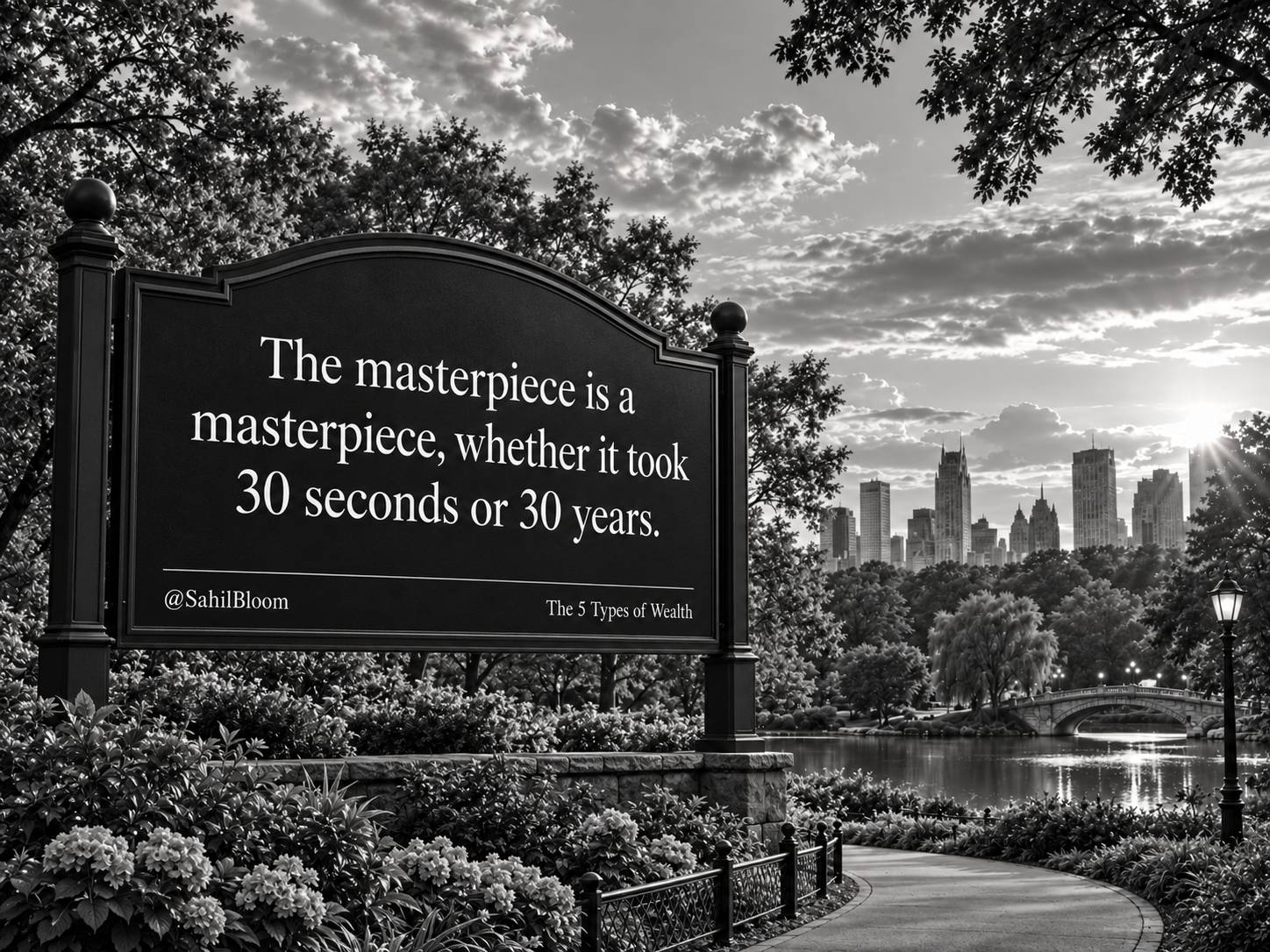
The masterpiece is a masterpiece, whether it took 30 seconds or 30 years.