Click Here
Cart

Order the instant New York Times bestseller: The 5 Types of Wealth

Order My NYT Bestselling Book

The Life-Changing Magic of Active Optimism

Sahil Bloom

Welcome to the 242 new members of the curiosity tribe who have joined us since Wednesday. Join the 57,887 others who are receiving high-signal, curiosity-inducing content every single week.

What’s a Rich Text element?

The rich text element allows you to create and format headings, paragraphs, blockquotes, images, and video all in one place instead of having to add and format them individually. Just double-click and easily create content.

Static and dynamic content editing

A rich text element can be used with static or dynamic content. For static content,

just drop it into any page and begin editing. For dynamic content, add a rich text field to any collection and then connect a rich text element to that field in the settings panel. Voila!

  • mldsa
  • ,l;cd
  • mkclds

How to customize formatting for each rich text

Headings, paragraphs, blockquotes, figures, images, and figure captions can all be styled after a class is added to the rich text element using the "When inside of"

nested selector

system.

There’s an old children’s fable I recently retold to my son…

A farmer was driving his wagon along a dirt road when it began to rain, transforming the road into a muddy mess.

Suddenly, one wheel sank deep into the mud and became completely stuck.

The farmer got off the wagon and stared at the wheel, cursing his bad luck and complaining about the delay. He turned his head to the sky and called on Hercules to come to his aid.

Hercules appeared, but rather than lifting the wagon, he spoke:

“Do you think you can move the wagon by simply looking at it? Put your shoulder to the wheel.”

The farmer did so, and the wagon lurched forward as the wheel easily came unstuck. He climbed back onto the seat and continued on his way.

The simple read says this is a story about effort. But it’s also a story that frames one of the most important traits in life:

It’s what I call Active Optimism:

A belief that things will work out paired with a willingness to do the work to make it true.

In a ​2019 study​ that looked at over 70,000 individuals, researchers at Harvard and Boston University found that optimism, defined as the general expectation that good things will happen, was connected to longevity.

Specifically, the most optimistic men and women had, on average, an 11–15% longer lifespan than the least optimistic.
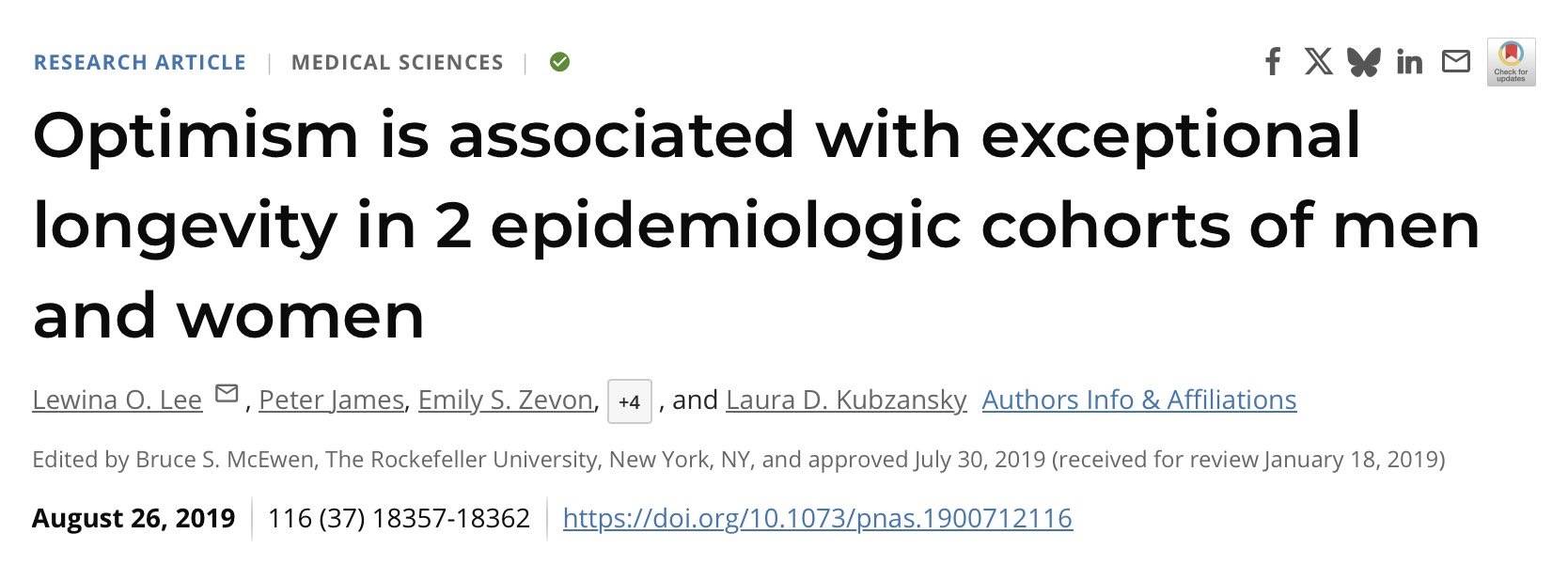
Importantly, the relationship between optimism and longevity was independent of the most obvious factors, including wealth, existing health conditions, relationships, and basic health behaviors.

In other words, the effect of optimism was not explained by the “usual suspects” when it comes to longevity studies.

There’s something deeper going on…

Real optimism isn’t about passive belief. It’s a foundational lens that impacts what you do.

In a ​1986 study​, psychologists Martin Seligman and Peter Schulman gave incoming MetLife agents a questionnaire that assessed their views on setbacks on a spectrum from permanent and pervasive (“I’m no good at this”) to temporary and specific (“that call went badly”).

Agents in the top half of optimism (those who viewed rejection as a passing event) outsold the bottom half by over 37%.

MetLife allowed them to take it a step further, hiring a “special force” of 129 applicants who had failed the company’s standard aptitude test but scored optimistic on the researchers’ questionnaire.

The group of “unqualified” optimists outsold the actual hires by 21% in the first year and 57% in the second year.

The pessimists saw mostly closed doors. The optimists saw mostly open doors, but even in the closed ones, they saw an opportunity to kick them open along the way.

The pattern shows up everywhere:

A 2006 meta-analysis by Suzanne Segerstrom and Lise Solberg Nes, which pooled 50 studies and more than 11,000 people, found that optimists consistently confronted stressors. They engaged, rather than avoided, them. They didn’t deny the existence of struggle. They leaned in where pessimists leaned away.

The researchers frame it this way: The action follows the positive belief. Put simply, the belief that things will turn encourages the action to make it true.

I believe that there are really two types of optimism:

  1. Passive Optimism
  2. Active Optimism

Passive Optimism is exclusively about belief. The belief that things will work out. Blind faith. It’s the farmer, wheel stuck in the mud, calling to the heavens for Hercules to come down and get him unstuck, deeply convinced that he would do just that.

Active Optimism is about belief that begets action. The belief that things will work out, and the action to make sure they do. Earned faith. It’s the same farmer, scolded by Hercules, putting his shoulder to the wheel, and seeing it break free with ease.

Passive Optimism fails for the same reason Pessimism does. Because it doesn’t move. Faced with a stuck wheel, the pessimist does nothing because he thinks it’s hopeless. The passive optimist does nothing because he thinks he doesn’t have to.

And this is something I think we all need to identify in ourselves:

Where are you being a passive optimist in your own life?

Because the reality is that passive optimism can often masquerade as patience, faith, or even wisdom. It’s the career path that will sort itself out. It’s the relationship struggle that will surely disappear with time. It’s the health issue that will eventually go away.

Belief is great. Faith is great. But without appropriate action, they are a recipe for long-term disappointment.

A mentor once told me this:

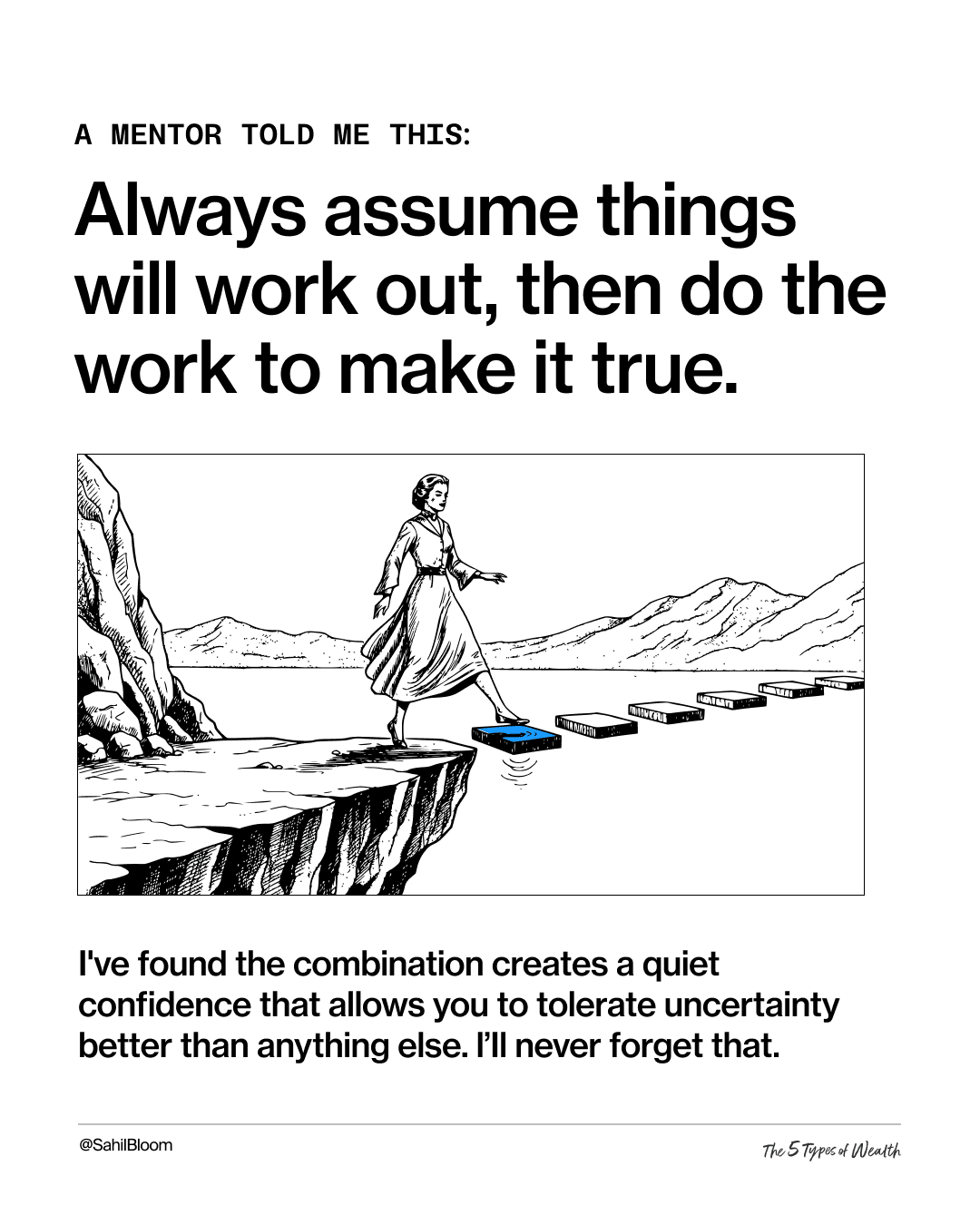
Always assume things will work out, then do the work to make it true. That combination creates a quiet confidence that allows you to tolerate uncertainty better than anything else.

It’s a mindset of Active Optimism. Belief and action.

Trust that the wheel will budge, as long as you’re willing to make it.

So, put your shoulder to the wheel.
The Life-Changing Magic of Active Optimism

Sahil Bloom

Welcome to the 242 new members of the curiosity tribe who have joined us since Wednesday. Join the 57,887 others who are receiving high-signal, curiosity-inducing content every single week.

What’s a Rich Text element?

The rich text element allows you to create and format headings, paragraphs, blockquotes, images, and video all in one place instead of having to add and format them individually. Just double-click and easily create content.

Static and dynamic content editing

A rich text element can be used with static or dynamic content. For static content,

just drop it into any page and begin editing. For dynamic content, add a rich text field to any collection and then connect a rich text element to that field in the settings panel. Voila!

  • mldsa
  • ,l;cd
  • mkclds

How to customize formatting for each rich text

Headings, paragraphs, blockquotes, figures, images, and figure captions can all be styled after a class is added to the rich text element using the "When inside of"

nested selector

system.

There’s an old children’s fable I recently retold to my son…

A farmer was driving his wagon along a dirt road when it began to rain, transforming the road into a muddy mess.

Suddenly, one wheel sank deep into the mud and became completely stuck.

The farmer got off the wagon and stared at the wheel, cursing his bad luck and complaining about the delay. He turned his head to the sky and called on Hercules to come to his aid.

Hercules appeared, but rather than lifting the wagon, he spoke:

“Do you think you can move the wagon by simply looking at it? Put your shoulder to the wheel.”

The farmer did so, and the wagon lurched forward as the wheel easily came unstuck. He climbed back onto the seat and continued on his way.

The simple read says this is a story about effort. But it’s also a story that frames one of the most important traits in life:

It’s what I call Active Optimism:

A belief that things will work out paired with a willingness to do the work to make it true.

In a ​2019 study​ that looked at over 70,000 individuals, researchers at Harvard and Boston University found that optimism, defined as the general expectation that good things will happen, was connected to longevity.

Specifically, the most optimistic men and women had, on average, an 11–15% longer lifespan than the least optimistic.

Importantly, the relationship between optimism and longevity was independent of the most obvious factors, including wealth, existing health conditions, relationships, and basic health behaviors.

In other words, the effect of optimism was not explained by the “usual suspects” when it comes to longevity studies.

There’s something deeper going on…

Real optimism isn’t about passive belief. It’s a foundational lens that impacts what you do.

In a ​1986 study​, psychologists Martin Seligman and Peter Schulman gave incoming MetLife agents a questionnaire that assessed their views on setbacks on a spectrum from permanent and pervasive (“I’m no good at this”) to temporary and specific (“that call went badly”).

Agents in the top half of optimism (those who viewed rejection as a passing event) outsold the bottom half by over 37%.

MetLife allowed them to take it a step further, hiring a “special force” of 129 applicants who had failed the company’s standard aptitude test but scored optimistic on the researchers’ questionnaire.

The group of “unqualified” optimists outsold the actual hires by 21% in the first year and 57% in the second year.

The pessimists saw mostly closed doors. The optimists saw mostly open doors, but even in the closed ones, they saw an opportunity to kick them open along the way.

The pattern shows up everywhere:

A 2006 meta-analysis by Suzanne Segerstrom and Lise Solberg Nes, which pooled 50 studies and more than 11,000 people, found that optimists consistently confronted stressors. They engaged, rather than avoided, them. They didn’t deny the existence of struggle. They leaned in where pessimists leaned away.

The researchers frame it this way: The action follows the positive belief. Put simply, the belief that things will turn encourages the action to make it true.

I believe that there are really two types of optimism:

  1. Passive Optimism
  2. Active Optimism

Passive Optimism is exclusively about belief. The belief that things will work out. Blind faith. It’s the farmer, wheel stuck in the mud, calling to the heavens for Hercules to come down and get him unstuck, deeply convinced that he would do just that.

Active Optimism is about belief that begets action. The belief that things will work out, and the action to make sure they do. Earned faith. It’s the same farmer, scolded by Hercules, putting his shoulder to the wheel, and seeing it break free with ease.

Passive Optimism fails for the same reason Pessimism does. Because it doesn’t move. Faced with a stuck wheel, the pessimist does nothing because he thinks it’s hopeless. The passive optimist does nothing because he thinks he doesn’t have to.

And this is something I think we all need to identify in ourselves:

Where are you being a passive optimist in your own life?

Because the reality is that passive optimism can often masquerade as patience, faith, or even wisdom. It’s the career path that will sort itself out. It’s the relationship struggle that will surely disappear with time. It’s the health issue that will eventually go away.

Belief is great. Faith is great. But without appropriate action, they are a recipe for long-term disappointment.

A mentor once told me this:

Always assume things will work out, then do the work to make it true. That combination creates a quiet confidence that allows you to tolerate uncertainty better than anything else.

It’s a mindset of Active Optimism. Belief and action.

Trust that the wheel will budge, as long as you’re willing to make it.

So, put your shoulder to the wheel.