


The Mindset That Changed My Entire Life

Today at a Glance
What’s a Rich Text element?
The rich text element allows you to create and format headings, paragraphs, blockquotes, images, and video all in one place instead of having to add and format them individually. Just double-click and easily create content.
Static and dynamic content editing
A rich text element can be used with static or dynamic content. For static content, just drop it into any page and begin editing. For dynamic content, add a rich text field to any collection and then connect a rich text element to that field in the settings panel. !
- ml;xsml;xa
- koxsaml;xsml;xsa
- mklxsaml;xsa
How to customize formatting for each rich text
Headings, paragraphs, blockquotes, figures, images, and figure captions can all be styled after a class is added to the rich text element using the "When inside of" nested selector system.
When I think about defining moments of my life, there's one story I come back to time and again:
I've written about it before, but never through the lens I want to use today.
I was 12 years old. I tried out for my first baseball all-star team. And I didn't make it. The coaches called the night tryouts ended and broke the news.
I ran to my room, sat down on my bed, put my head in my hands, and started to cry.
My dad walked in and sat down on the bed next to me. He sat there quietly for a few minutes, then spoke:
I understand you're upset. I get it. It sucks.
But here are the three things the coaches said you can work on.
Let's go out every day this summer and work on them together.
And we did. Damn near every single day. Countless hours. I came back the next year an entirely different player. A few years later, I earned a scholarship to play at Stanford University, my dream school.
But it all started there. Sitting on my bed. No rah-rah speech (my dad was never a big one for those, anyway). Just a few plain words.
But the lesson in them—and the science behind that lesson—unlocked a mindset that changed my entire life.
Allow me to explain...
Prior to the 1950s, the predominant viewpoints in the field of psychology said that humans were driven by forces outside their conscious control.
Freudian theory said that behavior was driven primarily by hidden, deep animal instincts and unconscious urges.
Behaviorism said that behavior was an automatic reaction to conditioning and environmental rewards or punishments.
Both schools of thought inherently treated the human as a passive object in the loop. You were either pushed by dark internal drives or pulled by external rewards.
In 1954, a psychologist named Julian Rotter added a piece he felt both were missing: You.
He called his new idea Social Learning Theory. It argued that expectations shape choices. Your belief about what will happen when you act has a significant impact on how you act.
For example, you might imagine two students who fail an exam:
- Student A says, "Hard work doesn't matter, the teacher just hates me." They establish an expectation that studying is useless, so they give up. They don't study for the next exam.
- Student B says, "I failed this one because I didn't study." They establish an expectation that studying has value, so they lean in. They study for the next exam.
There are two main elements to this theory:
- Expectancy: Your belief about how likely it is that a specific action will lead to a specific outcome.
- Reinforcement Value: How much you desire that specific outcome relative to other possible outcomes.
These two elements create four possibilities:
- Low Expectancy, Low Value: You don't believe your action can create the desired outcome, and the outcome has low value. You don't act.
- Low Expectancy, High Value: You don't believe your action can create the desired outcome, but that outcome has high value. You probably don't act.
- High Expectancy, Low Value: You believe your action can create the desired outcome, but that outcome has low value. You probably don't act.
- High Expectancy, High Value: You believe your action can create the desired outcome, and that outcome has high value. You act.
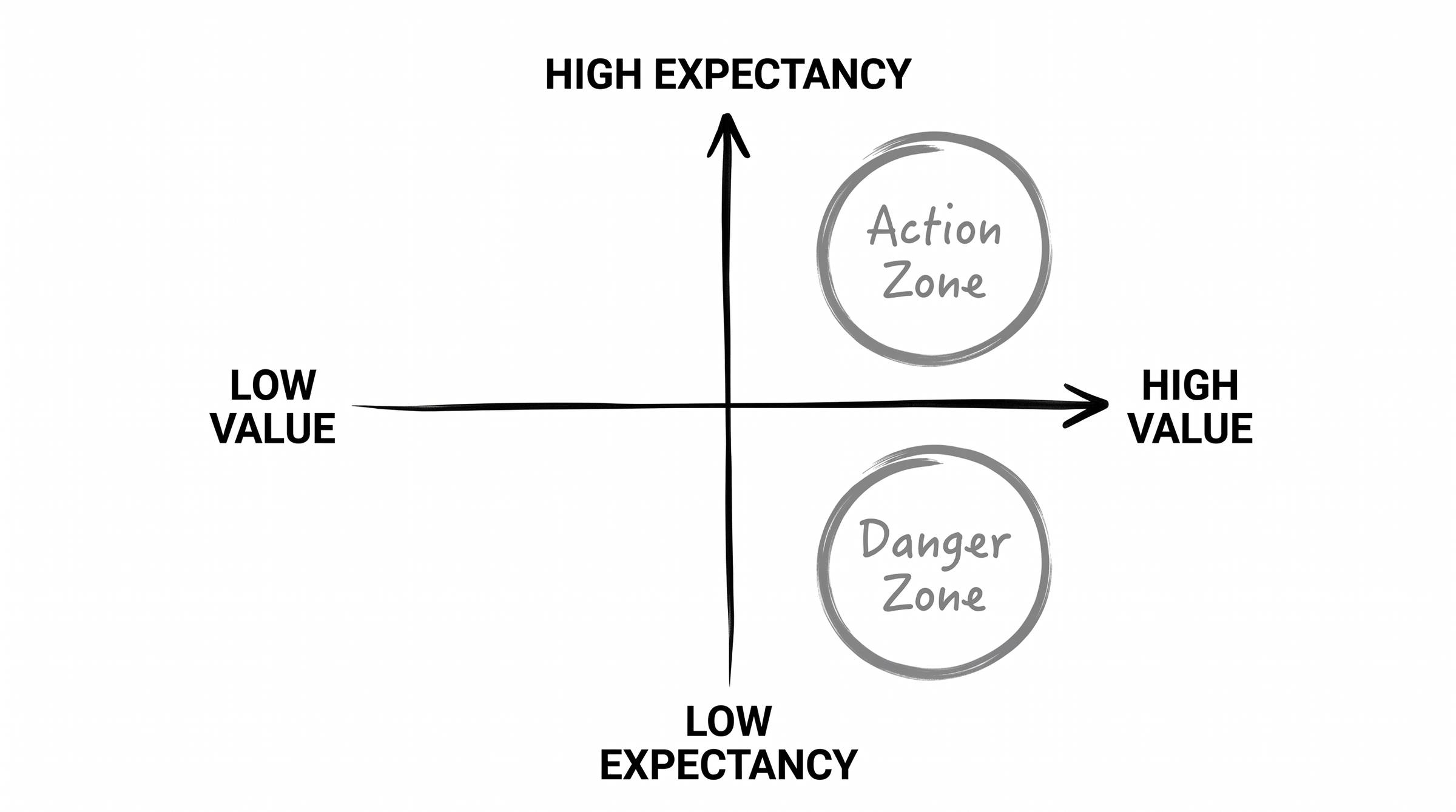
Low expectancy, high value. That's the one that's most damning. It's the thing you want but never go after, simply because you don't believe your actions can create it. It might be the dream job you never apply for. The business you never start. The physical side quest you never sign up for. Because you don't think your effort or energy can move the needle.
You tell yourself you're just being realistic. So you never act.
Where does that belief come from?
Julian Rotter believed you carry a default into every new situation, one that sets your expectations before anything happens:
He called it Locus of Control.
Locus of Control is the degree to which you believe you have control over the outcomes in your life.
- Those with an External Locus of Control believe that their outcomes are determined by forces outside their control. Blind luck, fate, or other people.
- Those with an Internal Locus of Control believe they have control over their outcomes through effort, focus, and attitude.
It's the baseline belief underneath everything. It's the lens you bring to every new challenge and experience.
Most of us sit somewhere in between the two. It's a spectrum, and our position on it can shift.
Which raises the question: If it can shift, can you shift it?
In the late 1960s, psychologists Martin Seligman and Steven Maier ran a series of controversial experiments that stumbled onto something remarkable.
A group of dogs were placed in harnesses and subjected to a series of small electric shocks. Some dogs could stop the shocks by pressing a lever, while others had no control over them.
Later, all the dogs were placed in a box where they could easily escape the shocks by jumping over a small barrier.
The dogs that had previously been in control of the lever quickly escaped. But most of the dogs that had no control over the shocks didn’t even try.
They could have escaped, but they sat still and accepted the shocks, even though freedom was right in front of them.
The finding became one of the most influential ideas in modern psychology.
At the time, Seligman and Maier called the phenomenon Learned Helplessness: When we become patterned to believe that nothing we do can change our situation, we stop taking action to change our situation.
But in 2016, 50 years later, Seligman and Maier co-authored an update, grounded in the latest neuroscience, which admitted they had gotten something wrong:
"The mechanism of learned helplessness is now very well-charted biologically, and the original theory got it backward."
The animals hadn't learned passivity. Passivity was the default state. It was control that was learned.
The brain doesn’t go looking for helplessness. Rather, it goes looking for control. When it detects evidence of that control, it switches off the passive default.
My own reading of the research is that helplessness is the factory setting you come out with, while agency is the update you install.
And here's the most fascinating part:
Evidence of control in one situation protected the animals from helplessness in later, different situations. The control had a carryover effect.
They called it behavioral immunization.
Knowing this, I look back on that night on my bed differently. I see the real power in what my dad said and did.
He created evidence of control.
He handed me my agency. And then he showed up every single day to help me feel it.
I was extremely fortunate. Not everyone had a dad like mine who walked into their room on a night like that.
Many of the people who struggle with an external locus of control never had the people or environments that showed them that evidence. Who helped them create it. So, their default never got switched off.
You can't change who walked into your room when you were 12. But you can reshape what your room looks like today.
That happens through actions. Even the small ones. Because every piece of evidence carries over.
That happens through people. Who you surround yourself with. The belief they hold about what's possible.
And that happens through environments. The broader ecosystems you exist in. Because rising tides lift all boats. Positive-sum environments encourage you to think bigger and take on more.
None of this is to say you control everything. You don't.
But an internal locus of control is the mindset that you are always in control of something.
You can't control all of the hands you're dealt. But you can control how you play them.
So, the next time you catch yourself saying "I can't do that" or "What's the point," force a pause. Then ask yourself:
What's the tiniest action I can take right now to create evidence of my control?
Then, go do it.
And listen to the room around you. If the people are constantly saying "Must be nice..." or "Why bother," that's a clear signal of your environment reinforcing the default. Seek out the people and spaces that are optimistic about the future. That want you to think bigger. That believe effort creates outcomes.
Every piece of evidence has a ripple. Small things become big things.
I'll never forget that night. A 12-year-old kid, head in his hands, certain that somebody else had decided his future.
And a father, who sat there quietly, felt my pain, and then handed me back the part I could control.
Find the part you can control. Then go out every day and work on it.


