Click Here
Cart

Order the instant New York Times bestseller: The 5 Types of Wealth

Order My NYT Bestselling Book

Solomon's Paradox: Why You Can't Take Your Own Advice

Sahil Bloom

Welcome to the 242 new members of the curiosity tribe who have joined us since Wednesday. Join the 57,887 others who are receiving high-signal, curiosity-inducing content every single week.

What’s a Rich Text element?

The rich text element allows you to create and format headings, paragraphs, blockquotes, images, and video all in one place instead of having to add and format them individually. Just double-click and easily create content.

Static and dynamic content editing

A rich text element can be used with static or dynamic content. For static content,

just drop it into any page and begin editing. For dynamic content, add a rich text field to any collection and then connect a rich text element to that field in the settings panel. Voila!

  • mldsa
  • ,l;cd
  • mkclds

How to customize formatting for each rich text

Headings, paragraphs, blockquotes, figures, images, and figure captions can all be styled after a class is added to the rich text element using the "When inside of"

nested selector

system.
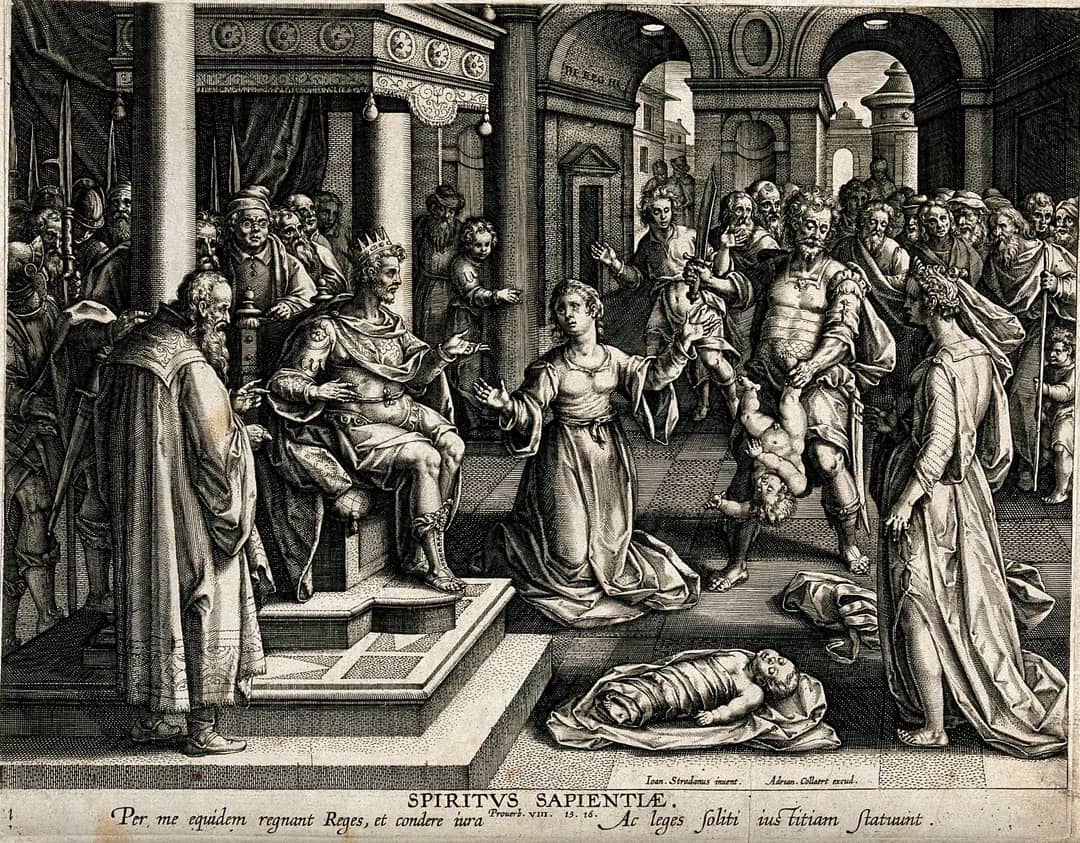
Engraving by Adrian Collaert, Designed by Jan van der Straet, 1523/1605

In the 10th century B.C., a young king was called upon to settle a seemingly impossible dispute.

Two women stood before him with a single child, both claiming to be its rightful mother. There were no witnesses. No evidence on which to base a judgment.

After hearing their case, the young king spoke:

"Get me a sword...Cut the living child in two, and give half to the one and half to the other."

At this, only one of the women cried out for the king to stop:

"Pardon me, my lord! Give her the living child, and by no means kill him!"

Hearing the plea, the young king had all the evidence he needed:

"Give [this] woman the living child, and by no means kill him. She is his mother."

He knew that only the real mother would cry out in agony at the thought of the baby being harmed.

The young king was named King Solomon, and this story, told in the Old Testament (1 Kings 3), gave birth to a legend.

King Solomon was known all the world around for his wisdom.

In fact, that wisdom was said to have been bestowed by God himself. In a dream, God appeared and granted him a single request. Rather than ask for wealth, health, power, or victory over his enemies, King Solomon replied:

"Give me an understanding heart so that I can govern your people well and know the difference between right and wrong"

That request was granted—and King Solomon's reputation as the wisest man who ever lived was born.

But unfortunately, that legendary wisdom and discernment regarding the affairs of others did not extend to his own life.

King Solomon had 700 wives, 300 concubines, a growing obsession with wealth, and a kingdom that collapsed within a generation of his death.

In short, King Solomon was great at giving advice, but bad at taking his own.

And to be fair, he was not alone...

Solomon's Paradox

As it turns out, this is a science-backed human phenomenon.

In 2014, a group of researchers at the University of Waterloo ran ​a series of experiments​ in which participants were asked to reflect on a conflict in their own romantic relationship or a conflict in someone else's relationship.

Participants were evaluated on markers of "wise reasoning," including:

  • Intellectual humility
  • Perspective-taking
  • Considering uncertainty
  • Searching for compromise

The psychologists wanted to answer a single question:

Are people wiser when reflecting on other people's problems compared with their own?

The answer was a resounding yes.

When it was someone else's conflict, participants were balanced, reflective, and nuanced. When it was their own, they showed more bias, less humility, more defensiveness, and less capacity to consider alternative viewpoints.

Pointing back to the story of King Solomon, the researchers named their finding Solomon's Paradox:

The tendency to reason more wisely about others’ problems than our own.

Ever wonder why you're able to provide clear, rational advice to others, but struggle to provide that same quality to yourself?

You are a victim of Solomon's Paradox. Here's how to escape it:

How to Escape Solomon's Paradox

Step 1: Practice Self-Distancing

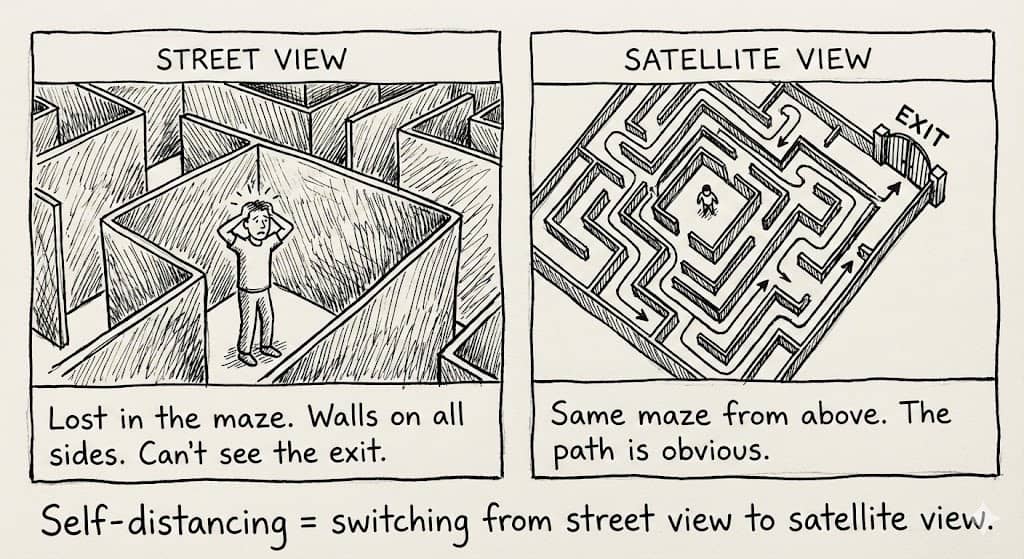
The primary driver of Solomon's Paradox is proximity.

You're too close to your problems. Your emotional connection to a situation clouds your better judgment. You try to protect your own ego. It makes you irrational. Biased. Defensive.

Self-distancing is the practice of creating space from the situation.

I think of self-distancing in two broad categories:

  1. Psychological: Creating psychological separation from the situation.
  2. Physical: Creating physical separation from the situation.

Psychological Self-Distancing can include:

  • Third-person self-talk. Refer to yourself by name ("What should Sahil do?" rather than "What should I do?").
  • Forced zoom out. Imagine yourself in the future, looking back on the present moment.
  • Slow, meditative breathing. A few slow, deep breaths can pull you back to center.

Physical Self-Distancing can include:

  • Change of scenery. Get out of the physical space where the situation is happening.
  • Active rest. Go for a short walk or drive to shift your perspective and clear your head.

Self-distancing is shown to reduce emotional connection to a situation, lower the threat to your ego, expand your cognitive flexibility, and increase integrative thinking.

Once you've created that space, you can move to the next step.
Step 2: Have a Self-Coaching Session

Imagine you had immediate access to a world class coach with a perfect, deep understanding of your life and context.

Well, it turns out, you do. That's you.

So, have a coaching session with yourself.

I use email—an email chain with myself—but any tool will work.

Pretend you're a third party coach and look at your current situation or struggle from that new vantage point.

To give you a deeper view of what this might look like, here's one such coaching conversation as I was wrestling with imposter syndrome surrounding my 2025 book launch:
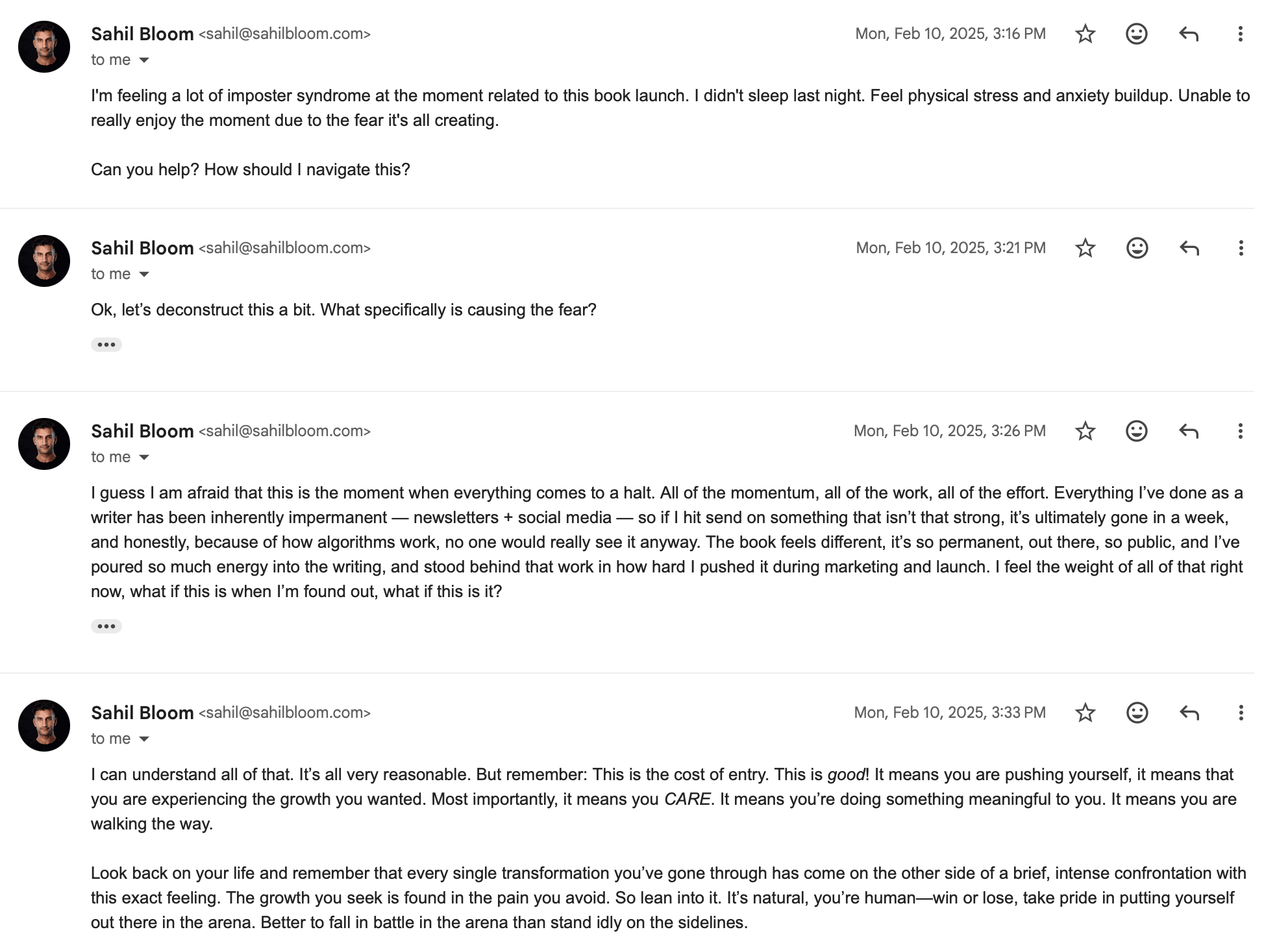
A few key lines that really helped:

  • "Let's deconstruct this a bit. What specifically is causing the fear?" This forced me to articulate the fear, break it down into real component parts, to understand its roots.
  • "Most importantly, it means you CARE. It means you're doing something meaningful to you." This reminded me that the fear is grounded in something positive.
  • "Look back on your life and remember that every single transformation you've gone through has come on the other side of a brief, intense confrontation with this exact feeling." This reminded me that my track record for getting through this is good, and that transformation follows.

If you're going to do one of these coaching sessions, a few prompts that help:

  1. Deconstruct: Ask yourself to deconstruct the fear or feeling.
  2. Zoom Out: Ask yourself to zoom out and see the bigger picture.
  3. Question Assumptions: Ask yourself whether the stories and assumptions are true, or if they're just embedded from perpetual use.

A coaching session with yourself may sound crazy. Trust me, it works.

Asking The Right Questions

King Solomon had the wisdom to solve everyone's problems but his own...

Unfortunately, this wasn't an isolated issue, but a human one. Most of us are the same.

We see our friends' situations with perfect clarity, but our own through a fog of emotion, ego, and fear.

But here's the real truth:

The wisdom you offer others is inside you. You just need to create the space to access and act upon it in your own life.

So, maybe escaping Solomon's Paradox is as simple as this:

The next time you face a struggle, don't ask, "What should I do?" Ask, "What would I tell my best friend to do?"

Then, take your own advice.

You already have the answers. You just haven't asked the right questions yet.

Solomon's Paradox: Why You Can't Take Your Own Advice

Sahil Bloom

Welcome to the 242 new members of the curiosity tribe who have joined us since Wednesday. Join the 57,887 others who are receiving high-signal, curiosity-inducing content every single week.

What’s a Rich Text element?

The rich text element allows you to create and format headings, paragraphs, blockquotes, images, and video all in one place instead of having to add and format them individually. Just double-click and easily create content.

Static and dynamic content editing

A rich text element can be used with static or dynamic content. For static content,

just drop it into any page and begin editing. For dynamic content, add a rich text field to any collection and then connect a rich text element to that field in the settings panel. Voila!

  • mldsa
  • ,l;cd
  • mkclds

How to customize formatting for each rich text

Headings, paragraphs, blockquotes, figures, images, and figure captions can all be styled after a class is added to the rich text element using the "When inside of"

nested selector

system.

Engraving by Adrian Collaert, Designed by Jan van der Straet, 1523/1605

In the 10th century B.C., a young king was called upon to settle a seemingly impossible dispute.

Two women stood before him with a single child, both claiming to be its rightful mother. There were no witnesses. No evidence on which to base a judgment.

After hearing their case, the young king spoke:

"Get me a sword...Cut the living child in two, and give half to the one and half to the other."

At this, only one of the women cried out for the king to stop:

"Pardon me, my lord! Give her the living child, and by no means kill him!"

Hearing the plea, the young king had all the evidence he needed:

"Give [this] woman the living child, and by no means kill him. She is his mother."

He knew that only the real mother would cry out in agony at the thought of the baby being harmed.

The young king was named King Solomon, and this story, told in the Old Testament (1 Kings 3), gave birth to a legend.

King Solomon was known all the world around for his wisdom.

In fact, that wisdom was said to have been bestowed by God himself. In a dream, God appeared and granted him a single request. Rather than ask for wealth, health, power, or victory over his enemies, King Solomon replied:

"Give me an understanding heart so that I can govern your people well and know the difference between right and wrong"

That request was granted—and King Solomon's reputation as the wisest man who ever lived was born.

But unfortunately, that legendary wisdom and discernment regarding the affairs of others did not extend to his own life.

King Solomon had 700 wives, 300 concubines, a growing obsession with wealth, and a kingdom that collapsed within a generation of his death.

In short, King Solomon was great at giving advice, but bad at taking his own.

And to be fair, he was not alone...

Solomon's Paradox

As it turns out, this is a science-backed human phenomenon.

In 2014, a group of researchers at the University of Waterloo ran ​a series of experiments​ in which participants were asked to reflect on a conflict in their own romantic relationship or a conflict in someone else's relationship.

Participants were evaluated on markers of "wise reasoning," including:

  • Intellectual humility
  • Perspective-taking
  • Considering uncertainty
  • Searching for compromise

The psychologists wanted to answer a single question:

Are people wiser when reflecting on other people's problems compared with their own?

The answer was a resounding yes.

When it was someone else's conflict, participants were balanced, reflective, and nuanced. When it was their own, they showed more bias, less humility, more defensiveness, and less capacity to consider alternative viewpoints.

Pointing back to the story of King Solomon, the researchers named their finding Solomon's Paradox:

The tendency to reason more wisely about others’ problems than our own.

Ever wonder why you're able to provide clear, rational advice to others, but struggle to provide that same quality to yourself?

You are a victim of Solomon's Paradox. Here's how to escape it:

How to Escape Solomon's Paradox

Step 1: Practice Self-Distancing

The primary driver of Solomon's Paradox is proximity.

You're too close to your problems. Your emotional connection to a situation clouds your better judgment. You try to protect your own ego. It makes you irrational. Biased. Defensive.

Self-distancing is the practice of creating space from the situation.

I think of self-distancing in two broad categories:

  1. Psychological: Creating psychological separation from the situation.
  2. Physical: Creating physical separation from the situation.

Psychological Self-Distancing can include:

  • Third-person self-talk. Refer to yourself by name ("What should Sahil do?" rather than "What should I do?").
  • Forced zoom out. Imagine yourself in the future, looking back on the present moment.
  • Slow, meditative breathing. A few slow, deep breaths can pull you back to center.

Physical Self-Distancing can include:

  • Change of scenery. Get out of the physical space where the situation is happening.
  • Active rest. Go for a short walk or drive to shift your perspective and clear your head.

Self-distancing is shown to reduce emotional connection to a situation, lower the threat to your ego, expand your cognitive flexibility, and increase integrative thinking.

Once you've created that space, you can move to the next step.

Step 2: Have a Self-Coaching Session

Imagine you had immediate access to a world class coach with a perfect, deep understanding of your life and context.

Well, it turns out, you do. That's you.

So, have a coaching session with yourself.

I use email—an email chain with myself—but any tool will work.

Pretend you're a third party coach and look at your current situation or struggle from that new vantage point.

To give you a deeper view of what this might look like, here's one such coaching conversation as I was wrestling with imposter syndrome surrounding my 2025 book launch:

A few key lines that really helped:

  • "Let's deconstruct this a bit. What specifically is causing the fear?" This forced me to articulate the fear, break it down into real component parts, to understand its roots.
  • "Most importantly, it means you CARE. It means you're doing something meaningful to you." This reminded me that the fear is grounded in something positive.
  • "Look back on your life and remember that every single transformation you've gone through has come on the other side of a brief, intense confrontation with this exact feeling." This reminded me that my track record for getting through this is good, and that transformation follows.

If you're going to do one of these coaching sessions, a few prompts that help:

  1. Deconstruct: Ask yourself to deconstruct the fear or feeling.
  2. Zoom Out: Ask yourself to zoom out and see the bigger picture.
  3. Question Assumptions: Ask yourself whether the stories and assumptions are true, or if they're just embedded from perpetual use.

A coaching session with yourself may sound crazy. Trust me, it works.

Asking The Right Questions

King Solomon had the wisdom to solve everyone's problems but his own...

Unfortunately, this wasn't an isolated issue, but a human one. Most of us are the same.

We see our friends' situations with perfect clarity, but our own through a fog of emotion, ego, and fear.

But here's the real truth:

The wisdom you offer others is inside you. You just need to create the space to access and act upon it in your own life.

So, maybe escaping Solomon's Paradox is as simple as this:

The next time you face a struggle, don't ask, "What should I do?" Ask, "What would I tell my best friend to do?"

Then, take your own advice.

You already have the answers. You just haven't asked the right questions yet.