The Doorman Fallacy

Today at a Glance
What’s a Rich Text element?
The rich text element allows you to create and format headings, paragraphs, blockquotes, images, and video all in one place instead of having to add and format them individually. Just double-click and easily create content.
Static and dynamic content editing
A rich text element can be used with static or dynamic content. For static content, just drop it into any page and begin editing. For dynamic content, add a rich text field to any collection and then connect a rich text element to that field in the settings panel. !
- ml;xsml;xa
- koxsaml;xsml;xsa
- mklxsaml;xsa
How to customize formatting for each rich text
Headings, paragraphs, blockquotes, figures, images, and figure captions can all be styled after a class is added to the rich text element using the "When inside of" nested selector system.
In his 2019 book, Alchemy, legendary British advertising executive Rory Sutherland offered an interesting lens on the perils of automation:
Imagine you are the owner of a five-star hotel and you hire a consulting firm to come in and propose opportunities for efficiency improvements.
The consultant observes the operations of the hotel and suggests that the role of the doorman can be automated. He currently costs $40,000 per year. You can install an automatic door-opening mechanism and save that money annually.
You accept the proposal, fire the doorman, and install the automatic door. The consultant walks away pleased with their great work (and the nice payday they received for it).
But that's not the end of the story...
Quoting Sutherland from a recent podcast interview:
Two years later, the hotel's a catastrophe...because the doorman was doing multiple things, many of which were human and kind of tacit. Security would be one...Hailing taxis, dealing with luggage, recognizing regular guests, providing status to the hotel—there are loads and loads of value creation components to that doorman which aren’t captured in the open-the-door definition.
Sutherland coined the term Doorman Fallacy to describe this phenomenon.
It arises when you ground your understanding of value in only the most visible function or skills, while failing to appreciate the full scope of tangible and intangible value that exists just under the surface.
I think this is broadly about differentiating between two things:
- Surface Value
- Real Value
Surface Value is what you immediately see. Real Value is what you don't.
When you default to assuming that a role or job is just the sum total of its Surface Value, you make costly decisions that ignore the Real Value hiding in plain sight.
You systematically misprice reality.
You're the captain of the Titanic, laughing off that little piece of ice jutting out from the surface of the water, only to realize your mistake when you crash into the reality that lies beneath it.
It's easy to see how this idea applies to the current cultural moment:
With AI-enabled efficiencies, automation, and job displacement top of mind, it offers a warning on the perils of the blind pursuit of efficiency.
Before we rush to automate or replace anything, the responsibility lies with all of us to slow down enough to develop a clear view on the Real Value being created by the thing (rather than just the Surface Value we immediately see).
But this isn't just a workplace problem. It shows up everywhere.
Every single day, you're faced with opportunities to optimize some area of your life. As you do so, you make a simple mental calculation that weighs the costs and value of the action against the optimized alternative.
So, for example, imagine you're thinking of hiring a meal prep company to replace the need to cook dinner for your family:
- Costs of Cooking: Well, it takes me one hour to cook dinner for my family in the evenings. I could get that hour back. Plus it would save time cleaning up afterwards since it would just be reheating the meals and a few dishes.
- Value of Cooking: My family eats dinner and has calories to survive.
Based on this, you decide to hire the meal prep company. The optimized alternative will get you back that time, deliver the same value, and it's reasonably priced relative to groceries.
But after a few months, something doesn't feel right. You're less connected to your family. Your kids grab their pre-prepared meals and eat in front of the TV. You and your partner grab yours and eat in front of your respective computers, firing off emails the entire time.
As it turned out, the Real Value of cooking dinner for your family went far beyond the Surface Value of the food and calories it provided. The Real Value had very little to do with food. It was about connection. About a ritual. About slowing down. About doing something together.
You can imagine a similar chain of events in any number of areas:
- You outsource your writing to AI, thinking it will make you more efficient, so you can create more. But you lose your ability to think. The Real Value of writing was not the output itself, but the thinking required to create it.
- You outsource your health to the latest shortcuts or gadgets, thinking it will make you healthier, faster. But you fail to become the type of person who engages in the disciplined pursuit of that health. The Real Value was not just the outcome, but who you became in the process of creating it.
- You outsource the management of your relationships to a system, thinking it will make you more efficient, so you can build and capture value from a broader network. But you find yourself lonely. The Real Value of building relationships was not the value received from them, but the depth of connection you created through the inefficient actions to build them in the first place.
In each case, the mistake is the same:
You optimized for Surface Value and unknowingly destroyed the Real Value that made the thing worth doing in the first place.
You optimized the life out of your life.
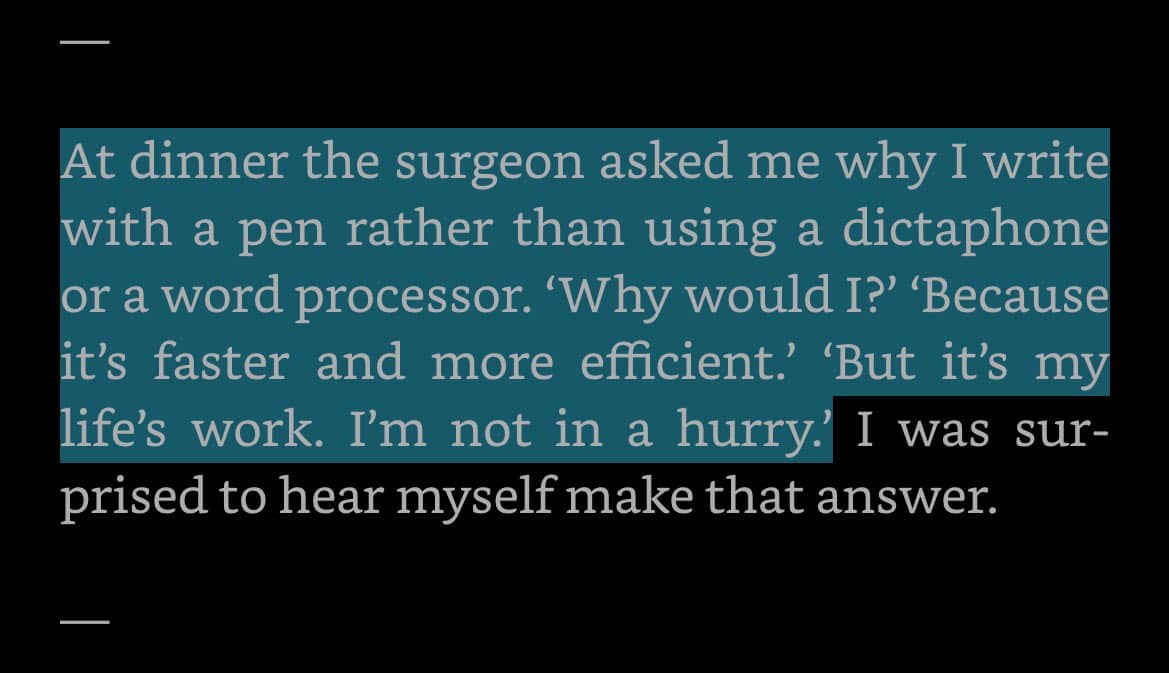
In a 1984 entry from her collected diaries, author Helen Garner captured this sentiment beautifully:
At dinner the surgeon asked me why I write with a pen rather than using a dictaphone or a word processor. 'Why would I?' 'Because it’s faster and more efficient.' 'But it’s my life’s work. I’m not in a hurry.'
Many of the most meaningful things in life look inefficient when viewed through the wrong lens. But that doesn't make them wasteful. It makes them human.
The doorman is much more than an automatic door opener.
So, slow down. Look deeper. And always make sure you understand the Real Value before you replace something in the name of efficiency.
This is your life's work. You're not in a hurry.