Amara’s Law: The Invisible Force That Shapes Your Life

Today at a Glance
What’s a Rich Text element?
The rich text element allows you to create and format headings, paragraphs, blockquotes, images, and video all in one place instead of having to add and format them individually. Just double-click and easily create content.
Static and dynamic content editing
A rich text element can be used with static or dynamic content. For static content, just drop it into any page and begin editing. For dynamic content, add a rich text field to any collection and then connect a rich text element to that field in the settings panel. !
- ml;xsml;xa
- koxsaml;xsml;xsa
- mklxsaml;xsa
How to customize formatting for each rich text
Headings, paragraphs, blockquotes, figures, images, and figure captions can all be styled after a class is added to the rich text element using the "When inside of" nested selector system.
In 1978, an American futurist named Roy Amara offered a reflection on the progression of technology:
“We tend to overestimate the effect of a technology in the short run and underestimate the effect in the long run.”
The statement—which later became known as Amara’s Law—was, in many ways, a reaction to the unique period of change that the technological world was experiencing.
Throughout the 1950s and 1960s, there was a great wave of techno-optimism. Computers were magical thinking machines that would solve all of our problems. Abundant nuclear energy was going to be too cheap to meter. This felt imminent.
But by the mid-late 1970s, that futuristic reality had not materialized. Computers existed, but they were clunky, expensive, and inaccessible to normal people. Energy was far from cheap for the average consumer.
For anyone who had lived through the techno-optimism of the 1950s and 1960s, it was easy to stand in the reality of the 1970s and feel disappointed.
However, that surface-level view missed an important truth:
Progress on the surface was not indicative of the compounding happening beneath it. Microprocessors were shrinking. Costs were falling. Networks were forming. Software was developing.
This was the insight that sparked Roy Amara’s famous reflection.
We overestimate the short-term effects and underestimate the long-term effects.
And, as you might have guessed, this reflection is about much more than technology. It’s about the way humans misjudge progress:
You judge the visible. You anchor on what you can see, touch, and feel. You’re comfortable with linear cause and effect. Take an action, create a visible outcome.
It’s simple, clear, and entirely wrong.
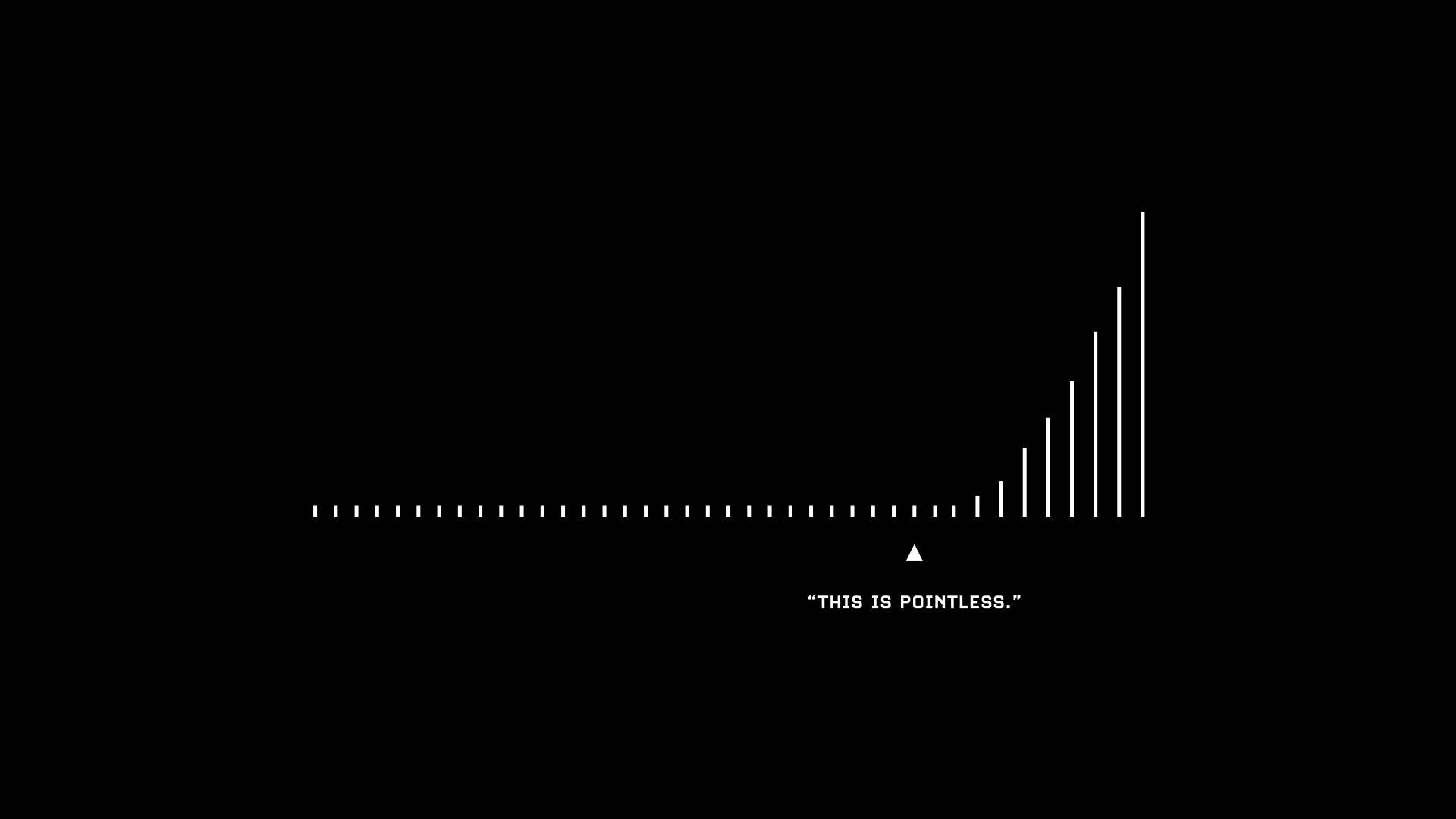
You think linearly, but most of life works exponentially—it benefits from compounding.
Today’s actions cannot be judged on the basis of today’s results. They quietly stack under the surface, for days, months, years, even decades. And then, suddenly, they appear.
So, I might propose a slightly revised version of Amara’s Law:
“We tend to overestimate the effect of our actions in the short run and underestimate the effect in the long run.”
In Ernest Hemingway’s famous 1926 novel, The Sun Also Rises, one of the characters is asked how he went bankrupt. His response:
Gradually, then suddenly.
Growth follows the same rule. It happens gradually, then suddenly.
If you focus on the visible, you’ll miss the invisible that tells the real story.
When you feel stuck, ask yourself these questions:
- What’s happening on the surface? What am I seeing?
- What’s happening at the foundation? What am I feeling (that’s unseen)?
If you can pause and do that, you’ll reclaim your perspective and play the game of life on an entirely different level.