


5 Life Learnings From 5 Years of The Curiosity Chronicle

Today at a Glance
What’s a Rich Text element?
The rich text element allows you to create and format headings, paragraphs, blockquotes, images, and video all in one place instead of having to add and format them individually. Just double-click and easily create content.
Static and dynamic content editing
A rich text element can be used with static or dynamic content. For static content, just drop it into any page and begin editing. For dynamic content, add a rich text field to any collection and then connect a rich text element to that field in the settings panel. !
- ml;xsml;xa
- koxsaml;xsml;xsa
- mklxsaml;xsa
How to customize formatting for each rich text
Headings, paragraphs, blockquotes, figures, images, and figure captions can all be styled after a class is added to the rich text element using the "When inside of" nested selector system.
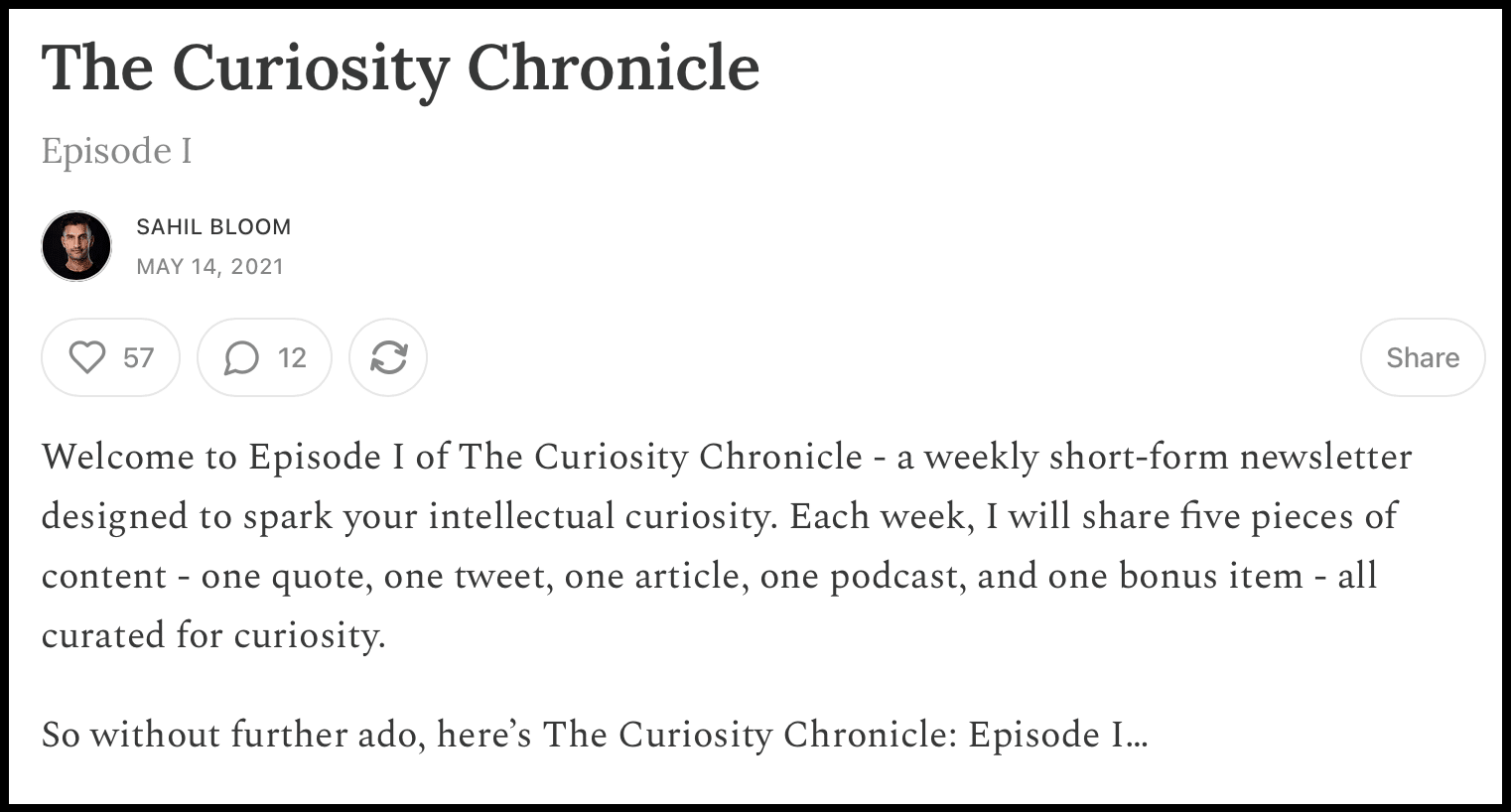
A few days ago, I was reminded by a reader that May 14 was the five year anniversary of my first Curiosity Chronicle newsletter.
Sending that first newsletter, which went out to a few thousand people who had been receiving my tweet threads in email format each week, felt like something of a leap of faith at the time.
Fast forward five years and what started with that tiny leap of faith has compounded into something beautiful.
I began reflecting on what I've learned through the five years of writing The Curiosity Chronicle and quickly realized that all of it applies well-beyond the bounds of creative pursuits and into any meaningful endeavor in life.
I hope these life learnings help you turn your tiny leap of faith into something beautiful...
1. Start ugly.
My favorite quote is from the ancient poet Rumi:
"As you start to walk on the way, the way appears."
It's a reminder that you can't plan your way into clarity. You have to act your way into it.
When I sat down to write my first newsletter, I was lost. I was 30 years old, living far from my family, with no idea what I was doing with my life. It's easy to look back and wind some impressive narrative on how I got from there to here, but that would do a disservice to the lived reality.
There was no strategy. No path. No vision.
But the good news? You don't need one.
You just need to start.
Because anything beautiful in this world started out ugly. And the only people who create beautiful things are those willing to do the ugly version first.
You won't be able to see the beautiful version yet. You won't even know what it could become. You just need to supply enough faith to get started.
Just start. Ugly.
2. Violent consistency is the only path to quality.
I recently came across a story in Art & Fear that I love:
A ceramics teacher split a class into two groups. One would be graded on the quantity of their output, the other would be graded on the quality of their output. On the final day, the first group would have their total output of pots weighed, while the second group would have one pot judged.
When grading day arrived, something fascinating happened:
"The works of highest quality were all produced by the group being graded for quantity. It seems that while the 'quantity' group was busily churning out piles of work—and learning from their mistakes—the 'quality' group had sat theorizing about perfection, and in the end had little more to show for their efforts than grandiose theories and a pile of dead clay."
Quantity is a necessary precursor to quality. You cannot create once and hope for it to be perfect. You have to create a lot. Every single day.
I think of it as violent consistency.
In the five years since I started this newsletter, I haven't missed a single issue. Two sends per week, every single week, for five years. I was violently consistent for a long time—and quality followed that consistency.
It's not going to be pretty. It's not going to draw oohs and aahs from the crowd. Because it looks messy in the days. It's getting out of bed when you don't want to. It's sitting down at your desk when you're tired. It's pounding your head into a wall one more time. It's ugly. It's unimpressive.
But it works.
Quality is a byproduct of quantity.
Violent consistency. That's the real recipe.
3. Think in decades (even while you act in days).
Here's the trap nobody warns you about: Violent consistency can quietly betray you.
Daily discipline without long-term direction is dangerous. You get so focused on moving that you stop asking what you're moving toward. You chase good instead of right. You optimize for the days and forget the decades.
And slowly, without realizing it, you drift away from what you were actually trying to build.
There's a question I started asking myself early on:
How would you approach what you're doing right now if you knew you'd be doing it for the next ten years?
The question helps you avoid the short-term traps that plague every endeavor. Chasing trends at the expense of authenticity. Chasing value extraction at the expense of value creation. Chasing monetization at the expense of energy and passion.
Every time I felt myself pulled into the short-term game, I reset my focus to the long-term one.
The question can be applied to every area of life:
How would you approach this relationship if you knew you'd be in it for the next ten years? You certainly wouldn't approach it as a transaction, with your hand out, looking to extract value.
How would you approach this workout if you knew you'd be training for the next ten years? You certainly wouldn't push yourself to injury chasing a single session.
How would you approach this work if you knew you'd be doing it for the next ten years? You certainly wouldn't cut corners to hit an arbitrary quarterly result.
Think long. Act now.
4. Trust is the atomic variable of all meaningful pursuits.
The world wants you to focus on the wrong thing.
When I first started writing, I remember being drawn by the vanity metrics that everyone seems to tout on social media. Views, likes, reshares, etc.
The problem with these metrics is that they are often misaligned with the most important thing:
Trust.
Everything is built on top of trust.
Fifty years ago. trust was centralized. Companies like P&G and Sears, Roebuck & Co had an iron grip on the airwaves. They dominated advertising across radio, television, magazines, and newspapers. They built trust—and commerce was layered on top of that trust.
Now, fast forward to today. Trust is rapidly decentralizing. You can build a trust node through the things you put out into the world—and commerce can be layered on top of that.
Trust is the atomic variable. Without it, you have nothing. With it, the rest takes care of itself.
But trust isn't built through views, likes, and reshares. It's built through value. Consistently creating value for people. With authenticity. With real connection. With unscalable actions.
It's harder to build, but you know it when you see it.
5. The world is permissionless.
I often wonder how many extraordinary people waste their entire lives waiting for permission from some invisible arbiter that doesn't even exist.
Misery loves those who wait. Those who look around waiting for someone to come tap them in. To give them permission to do the things they want to do.
I spent most of my life waiting for permission. Permission to live differently. Permission to pursue my weird interests. Permission to share things with the world.
But the truth is that we live in an increasingly permissionless world.
In the last 15 months, what started with that single newsletter has become the foundation of a New York Times bestselling book that's sold 400,000 copies and a natural skincare business that's reached a multi-million dollar run rate.
I don't say that to brag. I say it because there's nothing particularly special about me. Nobody told me I could do that. I just wanted to do it. So, I did it.
Technology has cracked the walls of credentialism.
Opportunity is more freely accessible than ever before. You don’t need a stamp of approval. You just need to create things of value. You just need to go do things.
Your entire life will change when you stop waiting for permission to live the life you want. Good things don’t come to those who wait. Good things come to those who tap themselves in.
The life you want is on the other side of the permission you give yourself to live it.
Five years ago, I hit send on a newsletter that I was almost embarrassed to put my name on.
Today, it's something I'm proud to call my own.
Wherever you are right now, your five years starts today. If it looks ugly, good. Ugly is fine. Ugly is the whole point.
Allow Rumi's words to echo in your head (as they echo in mine).
"As you start to walk on the way, the way appears."
That's all for now. I'll see you on the way.


