


Why You Need to Subtract: The Vasa Effect

Today at a Glance
What’s a Rich Text element?
The rich text element allows you to create and format headings, paragraphs, blockquotes, images, and video all in one place instead of having to add and format them individually. Just double-click and easily create content.
Static and dynamic content editing
A rich text element can be used with static or dynamic content. For static content, just drop it into any page and begin editing. For dynamic content, add a rich text field to any collection and then connect a rich text element to that field in the settings panel. !
- ml;xsml;xa
- koxsaml;xsml;xsa
- mklxsaml;xsa
How to customize formatting for each rich text
Headings, paragraphs, blockquotes, figures, images, and figure captions can all be styled after a class is added to the rich text element using the "When inside of" nested selector system.
In 1625, King Gustavus Adolphus of Sweden commissioned the building of a new warship.
At the time, Sweden was in the midst of a nearly 30-year-long war with Poland as the two powers battled for dominance of the Baltic region.
King Gustavus, often referred to as The Lion of the North for his aggressive military leadership, wanted the new warship to be a symbol of Sweden's military dominance over its rival.
He envisioned the ship as more than a military weapon. It would be something of a floating piece of propaganda, spreading the word of their strength with its very silhouette.
With the build underway, the king slowly increased his demands:
- An extension of the hull, pushing the ship's total length to a massive-for-the-era 69 meters
- Two fully enclosed gun decks instead of one
- 48 heavy bronze cannons and 16 smaller artillery arms
- Hundreds of gilded and painted carvings (of lions, Roman gods, emperors, and the like)
The warship would be the most expensive object Sweden had ever built.
In the summer of 1628, the ship, which was named the Vasa to honor the ruling Swedish royal family of the time, was ready for its final round of testing prior to setting sail.
During a standard 17th century procedure known as the stability trial, 30 sailors were placed on the upper deck and asked to run to one side of the ship all at once while the ship was moored at the pier.
The Vasa began heaving and rolling violently as the sailors shifted from side to side. It came so close to capsizing right there at the dock that the admiral running the test aborted the procedure in fear that it would sink on the spot.
Despite the aborted test, under unceasing pressure from the King, the admiral did not delay the maiden voyage, deciding the Vasa would be put to sea as planned.
On August 10, 1628, in front of an immense crowd of onlookers and foreign diplomats lining the shores, the Vasa set sail on a calm, clear afternoon from Stockholm harbor.
Just a few hundred meters into the journey, a light gust of wind caught the small sails and caused the ship to heel sharply to its port side. The onlookers gasped, but the ship quickly righted itself when the wind died down, and everyone breathed a collective sigh of relief.
Unfortunately, just 1,000 meters later, less than a mile into the maiden voyage, a gust of wind slammed into the sails and rolled the ship onto its side, submerging the open gun ports. Water rushed into the lower gun deck, causing the ship to quickly lose buoyancy.
Within a few minutes, the crowd of onlookers watched in horror as the mighty Vasa sank in just 100 feet of water, taking 30 of its 150-person crew down with it.
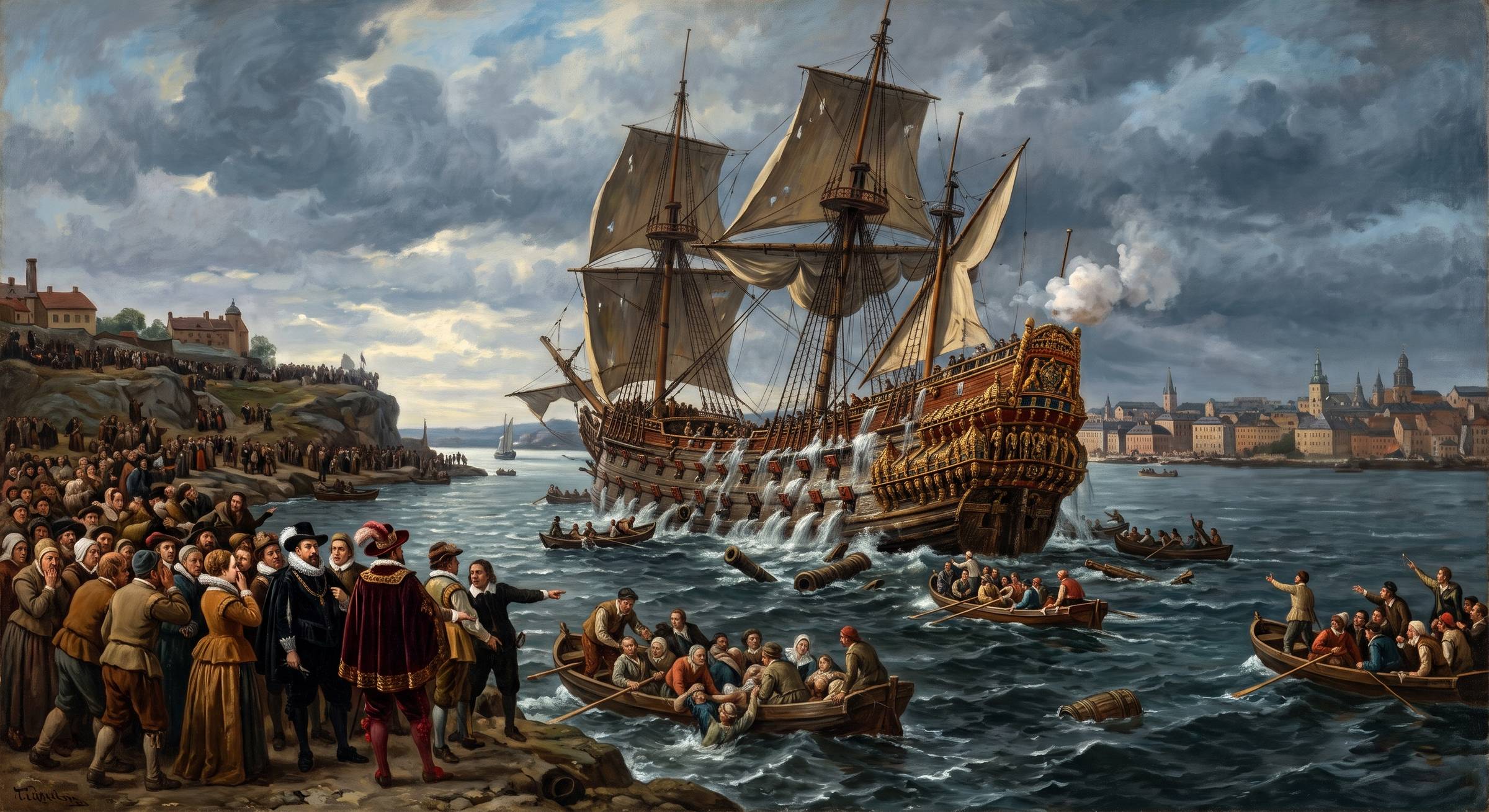
In the aftermath of the tragedy, a tribunal pointed fingers at the captain, the crew, and the builders, but no one looked at the true source of the failure:
The Lion of the North kept adding to his build.
Each individual addition may have made sense on its own merits:
- A longer ship meant a greater projection of power
- More cannons meant deadlier potential
- More gilded symbols meant a grander display of majesty
But put together, the sum of the additions was something catastrophic.
I like to call it the Vasa Effect:
The addition of individual positives can eventually create a catastrophic negative.
And to be sure, King Gustavus was not alone. This bias for addition is an all-too-common human phenomenon.
Dr. Leidy Klotz, an engineering and architecture professor at the University of Virginia, pioneered the study of the psychological bias toward addition.
After watching his young son fix a Lego structure by removing a block, an action the boy took while Klotz was reaching for a block to add, he became interested in studying this effect in the lab.
In one experiment, participants were shown a Lego structure with a wobbly platform held up by a single corner block. They were asked to make the structure stable enough to support a masonry brick to avoid it crushing the small Lego figure underneath.
They were told that every Lego brick they added would cost them 10 cents, and if they successfully completed the task, they would receive $1.
There were two concrete solutions to the problem:
- The Additive: Add three bricks to the other side to stabilize it. This would cost 30 cents and earn a 70 cent profit.
- The Subtractive: Remove a single brick to stabilize it. This would cost nothing and earn a $1 profit.
Only 41% of participants chose the subtractive path, despite it being a clear winner.
When a new group was given a note that removing pieces was free, that figure increased to 61%. The simple cue that subtraction was a viable option changed their approach significantly.
Klotz and his co-authors summarized their findings across eight experiments, writing, "people systematically default to searching for additive transformations, and consequently overlook subtractive transformations."
How often do we fall victim to this bias for addition in our own lives?
At the start of every year, we ask ourselves the same questions:
- What am I adding this year?
- What new habits will I build?
- What new resolutions can I create?
But in this bias to add, we often overlook that the fastest way to improve is to subtract.
And as the Lego study pointed out, it's often as simple as just adding a cue as a reminder that subtraction is an option in the first place.
Start asking yourself things like:
- What am I leaving behind?
- What am I quitting?
- What can I remove that's holding me back?
In his bestselling book on his research, Klotz quoted the philosopher Lao Tzu:
"To attain knowledge add things every day. To attain wisdom subtract things every day."
With addition, as with all things in life, the dose makes the poison. A little may be good, but a lot can be catastrophic. There's wisdom in creative subtraction.
So, before you add, always remind yourself that you can subtract.
It'll keep your ship sailing powerfully through whatever storms may come.


