Click Here
Cart

Order the instant New York Times bestseller: The 5 Types of Wealth

Order My NYT Bestselling Book

The Traffic Jam Theory of Success

Sahil Bloom

Welcome to the 242 new members of the curiosity tribe who have joined us since Wednesday. Join the 57,887 others who are receiving high-signal, curiosity-inducing content every single week.

What’s a Rich Text element?

The rich text element allows you to create and format headings, paragraphs, blockquotes, images, and video all in one place instead of having to add and format them individually. Just double-click and easily create content.

Static and dynamic content editing

A rich text element can be used with static or dynamic content. For static content,

just drop it into any page and begin editing. For dynamic content, add a rich text field to any collection and then connect a rich text element to that field in the settings panel. Voila!

  • mldsa
  • ,l;cd
  • mkclds

How to customize formatting for each rich text

Headings, paragraphs, blockquotes, figures, images, and figure captions can all be styled after a class is added to the rich text element using the "When inside of"

nested selector

system.

I was recently sent a New York Times ​article​ with a headline that stopped my scroll:
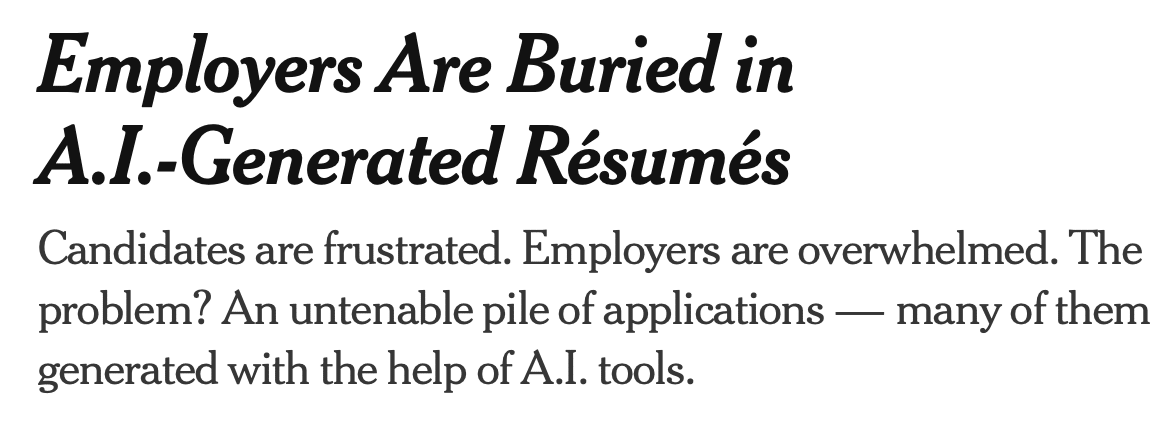
It opens with a story of an HR consultant in Utah who posted a role on LinkedIn for a technology company client. She knew it would be an attractive opportunity. It was fully-remote and required just three years of experience. But after just 12 hours, there were 400 applicants. A few days later, over 1,200. Months later, she was still sorting through the pile.

This anecdote is part of a much larger trend. Job applications on LinkedIn have surged to 11,000 per minute, a figure that's up nearly 50% vs. the prior year.

And AI appears to be a key driver behind the explosion:

With a simple prompt, ChatGPT, the chatbot developed by OpenAI, will insert every keyword from a job description into a résumé. Some candidates are going a step further, paying for A.I. agents that can autonomously find jobs and apply on their behalf. Recruiters say it’s getting harder to tell who is genuinely qualified or interested, and many of the résumés look suspiciously similar.

I found this article particularly interesting because it relates to one of the most common questions I seem to be getting over the last year:

How do I stand out and get ahead in the AI era?

This piece is my attempt to answer the question.

It's what I'd give my son if he were entering the job market today.

And honestly, it's what I'll come back and re-read whenever I need a reminder as well, because the principles apply much more broadly than you might initially realize.

My answer flows from an unlikely source:

In 1968, a German mathematician named Dietrich Braess used numerical analysis to build a traffic model. He noticed something strange: Adding a new shortcut road made traffic move slower, not faster.

Braess' Paradox says that with individuals making self-interested optimizing decisions, the addition of a shortcut can lead to sub-optimal performance for everyone.

In other words, when a new shortcut exists, everyone floods into it, which paradoxically makes everyone slower than they were before it existed.

The fast lane becomes the slow lane.

This finding was later observed in a variety of real world case studies, including in Seoul, South Korea, where traffic around the city ​improved​ after an expressway was removed as part of a restoration project.

Braess' Paradox provides a useful lens through which to view the AI era. I think of it as my Traffic Jam Theory of Success:

A new shortcut has been created. It's an everything shortcut. To find jobs. To apply to jobs. To network. To cold outreach. To build relationships. And it's effectively free. So, everyone floods into it. And suddenly, paradoxically, the entire system slows down for everyone.

The shortcut, meant to make your life easier and smoother, makes it harder and decidedly bumpier.

The fast lane becomes the slow lane.

So if everyone is flooding the new, exciting shortcut, where do you find the open road today?

Investor Charlie Songhurst has a great model for thinking about this question in the context of investing:

He places companies on a 2x2 matrix with coolness (from boring to sexy) on the X-axis and complexity (from simple to complex) on the Y-axis.
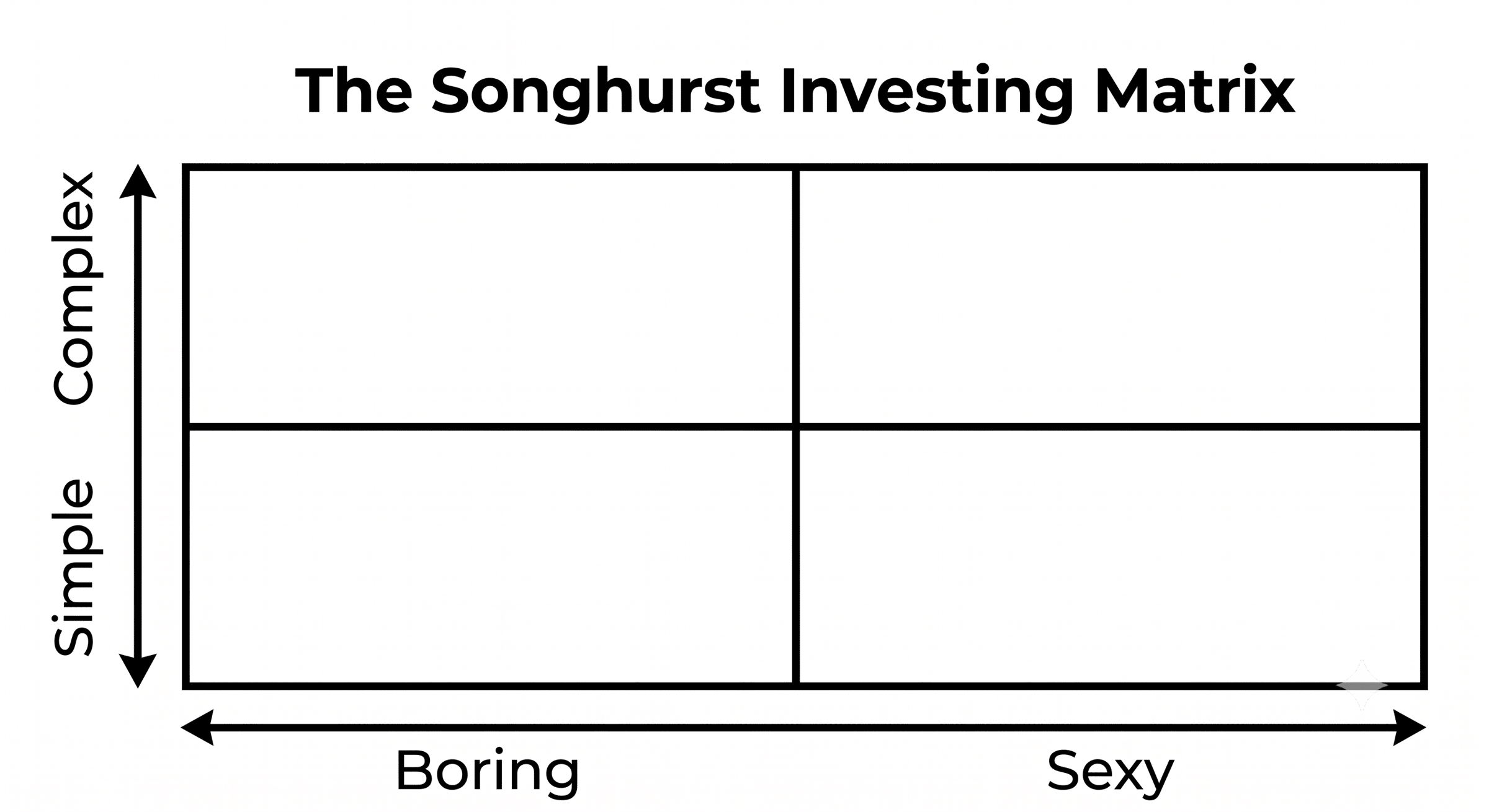
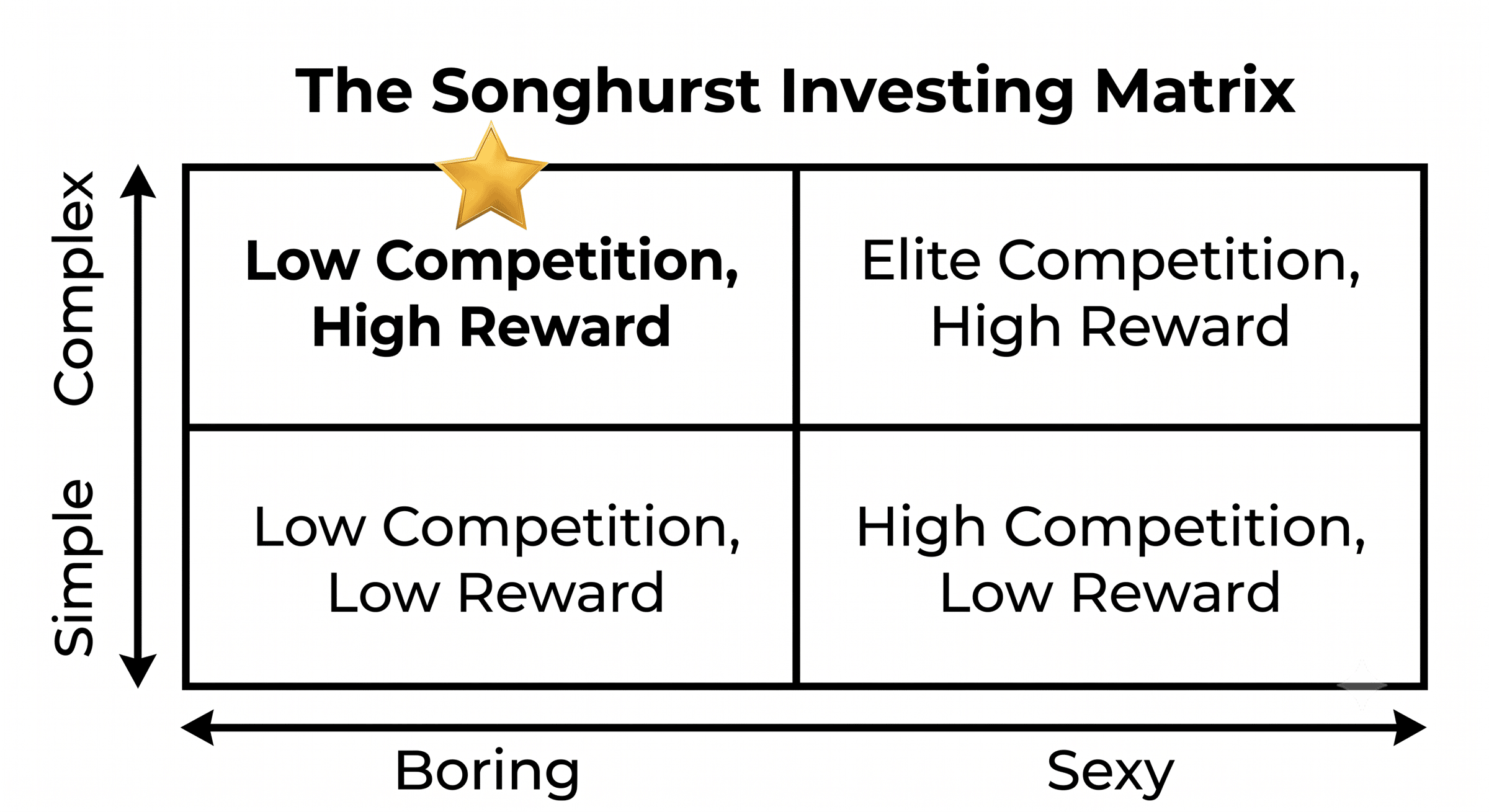
The relative attractiveness of the industry or market attracts competition, so as you move to the right, competition increases. And the relative complexity of the problem being solved determines the rewards, so as you move up, rewards increase.

With this, we can think of the quadrants as follows:

  • Top-Right (Sexy, Complex): Elite Competition, High Reward. The best talent flocks to this quadrant for the excitement and challenge.
  • Bottom-Right (Sexy, Simple): High Competition, Low Reward. The densest competition exists here. Very little barrier to entry, but maximum excitement.
  • Bottom-Left (Boring, Simple): Low Competition, Low Reward. The lack of excitement and rewards means this is something of a dead zone.
  • Top-Left (Boring, Complex): Low Competition, High Reward. The lack of excitement repels novelty-seekers and the challenge repels ease-seekers.

With this framing, Songhurst argues that the best place to play (or in his case, invest) is in the top-left quadrant. This is where you find the least competition with the most significant rewards.
I think we can take the model the matrix provides and expand it beyond investing and into the realms of careers, networking, relationship-building, and life.

What we're witnessing is the real-time impact of a new, easy, exciting shortcut being built every single day.

AI is creating an enormous amount of gravity toward the bottom-right quadrant of the matrix.

And in a world where everyone floods into that shortcut, you improve your odds of standing out and winning by staying in the top-left.

When there's a traffic jam forming in the fast lane, you get there faster by staying in yours.

What does that mean in the realms we're talking about?

Well, when something becomes cheap, easy, and exciting to automate, the output itself stops carrying useful signal. The thousands of carbon copy job applications with the same keywords inserted in the same places. The cold outreach emails with the same syntax and the same "personalization" dropped into the same bracketed locations. Those things no longer hold value because everyone is doing them. In fact, they may even carry negative signal as people push back against AI automation.

This idea extends across other relationship domains as well.

During my book launch in 2025, I wrote handwritten notes to about 500 people to whom I sent early copies of the book. I hand marked pages I thought that person would like based on my relationship with them and specifically mentioned those pages in the notes. It took well over 100 hours, but paid off in the form of extraordinary support from people who got early copies.

I later found out that a few authors I know were replicating the strategy, but in an automated, scalable manner. They had the publisher insert printed "handwritten" notes and generically mark a set of pages in their early send copies. It was quick, efficient, and entirely ineffective.

I've had friends who started using an AI agent to automate a system for sending flowers with loving notes to their partners on a weekly basis. They were surprised when the magic wore off right around the time their partner realized it was automated.

When it's cheap, easy, and exciting to automate, the output itself stops carrying useful signal.

The signal moves to the things that can't be faked.

This is the atomic insight to carry into your career and networking pursuits if you want to stand out. Here's how you can apply it:

1. Quality Shots > Total Shots

People seem to think that job applications and networking are a numbers game. That if you fire off more shots you increase your odds of success.

But as we've shown, with the cost of shots at near-zero, that just isn't the case. If anything, more shots decrease your odds of success.

Shift your mindset away from Total Shots to focus on Quality Shots.

Quality Shots are targeted. They're precise. They're hyper-individualized. They require real effort and intention. This means they require real time.

You aren't going to be applying to thousands of jobs. Sending thousands of cold emails. Or firing off thousands of automated notes. You're going to be putting sincere, deep, focused effort on a few.

2. Treat the job application like the first day of work.

The standard job application makes it almost impossible to stand out. It's supposed to capture your potential value in solving problems for the company or client in a single page.

Instead, act like you already have the job. What would you be doing to show value from Day 1?

Do some real upfront work:

  • What does the company need?
  • What problems do they need to solve?
  • What are their core challenges or gaps?

Then, work up some solutions. This is where you can really shine:

  • How would you solve those problems or challenges?
  • What skills can you leverage on their behalf?
  • Create an outline or mock up of the solutions. A simple memo. An example video. Whatever.

This isn't about the answers being perfect. After all, you don't work there yet and have relatively limited information. It's about showing real, un-fake-able attention and energy in the process.

It also demonstrates high figure-it-out-ability. There's nothing more valuable than someone who can just figure it out. Anyone who's ever hired will tell you that.

Once you've done this work, don't just toss it into the application pile. Try to find a side door. Do some digging on the key individuals that the role would be working with. Find a way to get the work to them.

The hit rate won't be 100%. Some of your energy will go unnoticed. You won't always get responses. But the quality of your shots, and thus your odds of success, will skyrocket.

3. Reverse engineer cold outreach for success.

The one trick that really helped me with cold outreach:

Pretend you're on the other side of it and reverse engineer what would make it successful.

In other words, imagine yourself as the busy, successful person being sent hundreds of these messages:

  • What would make it stick?
  • What would make it valuable?
  • What would improve the odds of landing?

Then, do that.

I think a good cold outreach message has six features:

  1. It's short and simple. Stop with the long cold emails. They make eyes glaze over and get deleted. 4-5 lines, space them out with hard enters (makes them appear more digestible).
  2. It has a simple, direct subject line. Stop with the shock factor cold emails. They may get an open, but the person won't take you seriously (sorry). Just be direct.
  3. It has clear, non-AI personalization. Make sure it's clear it's not a mass email. If I get one more "Sahil, your 800,000 Curiosity Chronicle subscribers are a clear sign of the value you provide" email, I'm going to lose my mind. Just do the unscalable thing. Learn something about the person you're sending it to and include that detail.
  4. It has a bit of social proof on why the person should take you seriously. What have you done? What makes you different or interesting? What was a time when you just figured it out?
  5. It creates some value for the person. Don't "gate it" behind a follow-up call or email, just share it. If you're pitching a service or applying for a job, create a mock-up of what you'd do and include it in the email. If you're trying to get an interview, include a doc breaking down your observations about the company and opportunities.
  6. It should end with a clear call-to-action. Ideally a single line, short sentence, and bolded or clearly standing out from the email.

And please don't input that list into Claude or ChatGPT and get it to automate that for you. Remember, when everyone floods into the easy way, it becomes an anti-signal.

4. Go offline.

This is the ultimate "old fashioned" advice. I can already see the "Ok, Boomer" replies flooding in, but that's alright, because I stand by it.

I don't care what anyone says. Real, in-person, human interaction is still the gold standard for creating connection and opening doors.

If you're not having any success with the traditional online applications and outreach, go offline.

  • Go to a conference or industry event.
  • Drop off your application, proof of work, and resume in person. It may feel weird, but I guarantee it will get you noticed outside the normal LinkedIn application pile.
  • Save up and buy a ticket to a retreat or mastermind that might have a few attendees or speakers you'd like to spend time with.

Again, when you do things the hard way, it stands out from the traffic jam of people doing things the easy way.

To be clear, you can use AI as part of doing the work on the back-end of all of this. This isn't an anti-AI manifesto, per se.

You can automate utility, but not humanity.

In other words, where utility is the goal (uncovering a piece of information to use, brainstorming, pressure testing thinking, etc.), use AI. But don't use it where humanity and personal connection matter. Where showing real humanness is an edge, where it stands out in the sea. Where it's clear proof of taking the long way. Where it avoids the traffic jam.

The world will pressure you to take the fast lane. To do things the easy, automated, and exciting way.

But my Traffic Jam Theory of Success says otherwise. Because when everyone rushes for the fast lane, it becomes the slow lane.

So, do the opposite. Take the long way. Do the work. Stay human.

It's what I'll tell my son someday. And what I keep telling myself today.

The Traffic Jam Theory of Success

Sahil Bloom

Welcome to the 242 new members of the curiosity tribe who have joined us since Wednesday. Join the 57,887 others who are receiving high-signal, curiosity-inducing content every single week.

What’s a Rich Text element?

The rich text element allows you to create and format headings, paragraphs, blockquotes, images, and video all in one place instead of having to add and format them individually. Just double-click and easily create content.

Static and dynamic content editing

A rich text element can be used with static or dynamic content. For static content,

just drop it into any page and begin editing. For dynamic content, add a rich text field to any collection and then connect a rich text element to that field in the settings panel. Voila!

  • mldsa
  • ,l;cd
  • mkclds

How to customize formatting for each rich text

Headings, paragraphs, blockquotes, figures, images, and figure captions can all be styled after a class is added to the rich text element using the "When inside of"

nested selector

system.

I was recently sent a New York Times ​article​ with a headline that stopped my scroll:

It opens with a story of an HR consultant in Utah who posted a role on LinkedIn for a technology company client. She knew it would be an attractive opportunity. It was fully-remote and required just three years of experience. But after just 12 hours, there were 400 applicants. A few days later, over 1,200. Months later, she was still sorting through the pile.

This anecdote is part of a much larger trend. Job applications on LinkedIn have surged to 11,000 per minute, a figure that's up nearly 50% vs. the prior year.

And AI appears to be a key driver behind the explosion:

With a simple prompt, ChatGPT, the chatbot developed by OpenAI, will insert every keyword from a job description into a résumé. Some candidates are going a step further, paying for A.I. agents that can autonomously find jobs and apply on their behalf. Recruiters say it’s getting harder to tell who is genuinely qualified or interested, and many of the résumés look suspiciously similar.

I found this article particularly interesting because it relates to one of the most common questions I seem to be getting over the last year:

How do I stand out and get ahead in the AI era?

This piece is my attempt to answer the question.

It's what I'd give my son if he were entering the job market today.

And honestly, it's what I'll come back and re-read whenever I need a reminder as well, because the principles apply much more broadly than you might initially realize.

My answer flows from an unlikely source:

In 1968, a German mathematician named Dietrich Braess used numerical analysis to build a traffic model. He noticed something strange: Adding a new shortcut road made traffic move slower, not faster.

Braess' Paradox says that with individuals making self-interested optimizing decisions, the addition of a shortcut can lead to sub-optimal performance for everyone.

In other words, when a new shortcut exists, everyone floods into it, which paradoxically makes everyone slower than they were before it existed.

The fast lane becomes the slow lane.

This finding was later observed in a variety of real world case studies, including in Seoul, South Korea, where traffic around the city ​improved​ after an expressway was removed as part of a restoration project.

Braess' Paradox provides a useful lens through which to view the AI era. I think of it as my Traffic Jam Theory of Success:

A new shortcut has been created. It's an everything shortcut. To find jobs. To apply to jobs. To network. To cold outreach. To build relationships. And it's effectively free. So, everyone floods into it. And suddenly, paradoxically, the entire system slows down for everyone.

The shortcut, meant to make your life easier and smoother, makes it harder and decidedly bumpier.

The fast lane becomes the slow lane.

So if everyone is flooding the new, exciting shortcut, where do you find the open road today?

Investor Charlie Songhurst has a great model for thinking about this question in the context of investing:

He places companies on a 2x2 matrix with coolness (from boring to sexy) on the X-axis and complexity (from simple to complex) on the Y-axis.

The relative attractiveness of the industry or market attracts competition, so as you move to the right, competition increases. And the relative complexity of the problem being solved determines the rewards, so as you move up, rewards increase.

With this, we can think of the quadrants as follows:

  • Top-Right (Sexy, Complex): Elite Competition, High Reward. The best talent flocks to this quadrant for the excitement and challenge.
  • Bottom-Right (Sexy, Simple): High Competition, Low Reward. The densest competition exists here. Very little barrier to entry, but maximum excitement.
  • Bottom-Left (Boring, Simple): Low Competition, Low Reward. The lack of excitement and rewards means this is something of a dead zone.
  • Top-Left (Boring, Complex): Low Competition, High Reward. The lack of excitement repels novelty-seekers and the challenge repels ease-seekers.

With this framing, Songhurst argues that the best place to play (or in his case, invest) is in the top-left quadrant. This is where you find the least competition with the most significant rewards.

I think we can take the model the matrix provides and expand it beyond investing and into the realms of careers, networking, relationship-building, and life.

What we're witnessing is the real-time impact of a new, easy, exciting shortcut being built every single day.

AI is creating an enormous amount of gravity toward the bottom-right quadrant of the matrix.

And in a world where everyone floods into that shortcut, you improve your odds of standing out and winning by staying in the top-left.

When there's a traffic jam forming in the fast lane, you get there faster by staying in yours.

What does that mean in the realms we're talking about?

Well, when something becomes cheap, easy, and exciting to automate, the output itself stops carrying useful signal. The thousands of carbon copy job applications with the same keywords inserted in the same places. The cold outreach emails with the same syntax and the same "personalization" dropped into the same bracketed locations. Those things no longer hold value because everyone is doing them. In fact, they may even carry negative signal as people push back against AI automation.

This idea extends across other relationship domains as well.

During my book launch in 2025, I wrote handwritten notes to about 500 people to whom I sent early copies of the book. I hand marked pages I thought that person would like based on my relationship with them and specifically mentioned those pages in the notes. It took well over 100 hours, but paid off in the form of extraordinary support from people who got early copies.

I later found out that a few authors I know were replicating the strategy, but in an automated, scalable manner. They had the publisher insert printed "handwritten" notes and generically mark a set of pages in their early send copies. It was quick, efficient, and entirely ineffective.

I've had friends who started using an AI agent to automate a system for sending flowers with loving notes to their partners on a weekly basis. They were surprised when the magic wore off right around the time their partner realized it was automated.

When it's cheap, easy, and exciting to automate, the output itself stops carrying useful signal.

The signal moves to the things that can't be faked.

This is the atomic insight to carry into your career and networking pursuits if you want to stand out. Here's how you can apply it:

1. Quality Shots > Total Shots

People seem to think that job applications and networking are a numbers game. That if you fire off more shots you increase your odds of success.

But as we've shown, with the cost of shots at near-zero, that just isn't the case. If anything, more shots decrease your odds of success.

Shift your mindset away from Total Shots to focus on Quality Shots.

Quality Shots are targeted. They're precise. They're hyper-individualized. They require real effort and intention. This means they require real time.

You aren't going to be applying to thousands of jobs. Sending thousands of cold emails. Or firing off thousands of automated notes. You're going to be putting sincere, deep, focused effort on a few.

2. Treat the job application like the first day of work.

The standard job application makes it almost impossible to stand out. It's supposed to capture your potential value in solving problems for the company or client in a single page.

Instead, act like you already have the job. What would you be doing to show value from Day 1?

Do some real upfront work:

  • What does the company need?
  • What problems do they need to solve?
  • What are their core challenges or gaps?

Then, work up some solutions. This is where you can really shine:

  • How would you solve those problems or challenges?
  • What skills can you leverage on their behalf?
  • Create an outline or mock up of the solutions. A simple memo. An example video. Whatever.

This isn't about the answers being perfect. After all, you don't work there yet and have relatively limited information. It's about showing real, un-fake-able attention and energy in the process.

It also demonstrates high figure-it-out-ability. There's nothing more valuable than someone who can just figure it out. Anyone who's ever hired will tell you that.

Once you've done this work, don't just toss it into the application pile. Try to find a side door. Do some digging on the key individuals that the role would be working with. Find a way to get the work to them.

The hit rate won't be 100%. Some of your energy will go unnoticed. You won't always get responses. But the quality of your shots, and thus your odds of success, will skyrocket.

3. Reverse engineer cold outreach for success.

The one trick that really helped me with cold outreach:

Pretend you're on the other side of it and reverse engineer what would make it successful.

In other words, imagine yourself as the busy, successful person being sent hundreds of these messages:

  • What would make it stick?
  • What would make it valuable?
  • What would improve the odds of landing?

Then, do that.

I think a good cold outreach message has six features:

  1. It's short and simple. Stop with the long cold emails. They make eyes glaze over and get deleted. 4-5 lines, space them out with hard enters (makes them appear more digestible).
  2. It has a simple, direct subject line. Stop with the shock factor cold emails. They may get an open, but the person won't take you seriously (sorry). Just be direct.
  3. It has clear, non-AI personalization. Make sure it's clear it's not a mass email. If I get one more "Sahil, your 800,000 Curiosity Chronicle subscribers are a clear sign of the value you provide" email, I'm going to lose my mind. Just do the unscalable thing. Learn something about the person you're sending it to and include that detail.
  4. It has a bit of social proof on why the person should take you seriously. What have you done? What makes you different or interesting? What was a time when you just figured it out?
  5. It creates some value for the person. Don't "gate it" behind a follow-up call or email, just share it. If you're pitching a service or applying for a job, create a mock-up of what you'd do and include it in the email. If you're trying to get an interview, include a doc breaking down your observations about the company and opportunities.
  6. It should end with a clear call-to-action. Ideally a single line, short sentence, and bolded or clearly standing out from the email.

And please don't input that list into Claude or ChatGPT and get it to automate that for you. Remember, when everyone floods into the easy way, it becomes an anti-signal.

4. Go offline.

This is the ultimate "old fashioned" advice. I can already see the "Ok, Boomer" replies flooding in, but that's alright, because I stand by it.

I don't care what anyone says. Real, in-person, human interaction is still the gold standard for creating connection and opening doors.

If you're not having any success with the traditional online applications and outreach, go offline.

  • Go to a conference or industry event.
  • Drop off your application, proof of work, and resume in person. It may feel weird, but I guarantee it will get you noticed outside the normal LinkedIn application pile.
  • Save up and buy a ticket to a retreat or mastermind that might have a few attendees or speakers you'd like to spend time with.

Again, when you do things the hard way, it stands out from the traffic jam of people doing things the easy way.

To be clear, you can use AI as part of doing the work on the back-end of all of this. This isn't an anti-AI manifesto, per se.

You can automate utility, but not humanity.

In other words, where utility is the goal (uncovering a piece of information to use, brainstorming, pressure testing thinking, etc.), use AI. But don't use it where humanity and personal connection matter. Where showing real humanness is an edge, where it stands out in the sea. Where it's clear proof of taking the long way. Where it avoids the traffic jam.

The world will pressure you to take the fast lane. To do things the easy, automated, and exciting way.

But my Traffic Jam Theory of Success says otherwise. Because when everyone rushes for the fast lane, it becomes the slow lane.

So, do the opposite. Take the long way. Do the work. Stay human.

It's what I'll tell my son someday. And what I keep telling myself today.