


The Michelangelo Phenomenon

Today at a Glance
What’s a Rich Text element?
The rich text element allows you to create and format headings, paragraphs, blockquotes, images, and video all in one place instead of having to add and format them individually. Just double-click and easily create content.
Static and dynamic content editing
A rich text element can be used with static or dynamic content. For static content, just drop it into any page and begin editing. For dynamic content, add a rich text field to any collection and then connect a rich text element to that field in the settings panel. !
- ml;xsml;xa
- koxsaml;xsml;xsa
- mklxsaml;xsa
How to customize formatting for each rich text
Headings, paragraphs, blockquotes, figures, images, and figure captions can all be styled after a class is added to the rich text element using the "When inside of" nested selector system.
The most famous sculpture in history was almost never created…
In 1464, the Opera del Duomo—the committee overseeing the cathedral in Florence—commissioned a massive statue to adorn the cathedral’s roofline.
They sourced a single, 17-foot block of marble from the quarries in Carrara, Italy.
A sculptor named Agostino di Duccio began work on the project, but after a short stint, he backed out.
A decade later, in 1476, a second sculptor named Antonio Rossellino was hired, but almost immediately walked away, citing the poor quality of the marble block that had been sourced.
It was brittle, difficult to carve, and structurally flawed—too narrow and tall for a full-sized statue to be created.
And so it was that a 17-foot block of (nearly) untouched marble came to rest in an open courtyard in Florence.
A year passed. Then five. Then ten. Then twenty.
That is, until 1501, a full 37 years since the original commission and 26 years since it had last been touched, when the committee gave the long-rejected slab of marble to a 26-year-old artist, offering him the job and two years to complete it.
His name was Michelangelo.
The sculpture, as you’ve probably now guessed, was David.
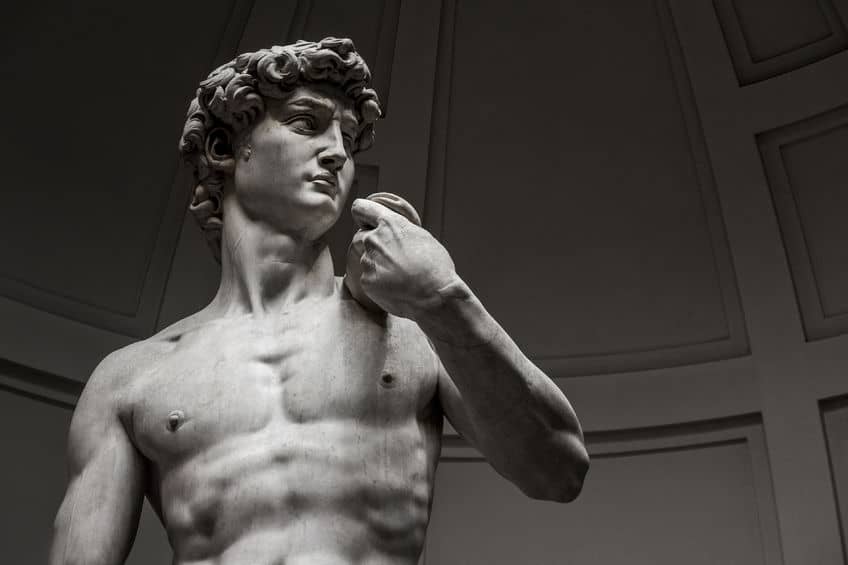
The story of how the commission came to him is an interesting one, but it’s the story of how he brought it to life that carries a deep, science-backed lesson I’ve never been able to forget.
Freeing the Angel Within
Michelangelo inherited something of a disaster.
Two separate sculptors had rejected the project. The marble was brittle, narrow, and weathered from the 25 years of exposure to the elements.
But despite all of this, he saw something others had missed. He had a vision for what the big, unhewn block could become.
So, he began chipping away, little by little, to reveal a truth that only he could see.
And on September 8, 1504, that truth was revealed to the world. The colossal statue of David was immediately lauded as a masterpiece.
In a quote widely attributed to Michelangelo, the artist described his process, saying:
“I saw the angel in the marble and carved until I set him free.”
Centuries later, Michelangelo’s process—seeing the ideal form hidden in the raw stone and chipping away to reveal it—inspired a group of psychologists to ask a fascinating question:
What if our deepest relationships work the same way?
In a 1999 paper, appropriately titled Close Partner as Sculptor of the Ideal Self, the psychologists found that when your partner sees you as the person you’re trying to become, they act in ways that support that vision and you actually move closer to that ideal self over time.
They called it the Michelangelo Phenomenon, a reference to the sculptor, who chipped away until he freed the angel within.
In a 2009 follow-up, the researchers further explained the nature of this finding.
Most importantly, they determined that it was not conscious:
Your partner doesn’t sit down and create a personal mandate to help you make this transformation. Rather, they just naturally create conditions that help promote the growth and development you’re focused on.
For example, they don’t say, “I’m going to help make you become a disciplined go-getter.”
Instead, they might do things like:
- Tackle some household duties to protect your morning workout time.
- Pick up an extra shift to encourage you to take the professional leap.
- Treat you like the person you’re becoming rather than the person you’ve been.
This creates a virtuous cycle in the relationship, where both individuals are sculpting each other through supportive actions, not words.
It is perhaps no surprise that the effect can also work in reverse. When a close partner acts indifferently towards your goals and aspirations, creating conditions that are reinforcing of the status quo (or worse), they can sculpt you away from that ideal version of yourself.
They roll their eyes when you mention your business idea. They tell you to be realistic about your ambitious goal. They never sacrifice their own well-being to create space for you to pursue yours.
The chisel cuts both ways, as it were.
The Michelangelo Phenomenon extends beyond romantic partnerships and into any close relationships, with friends, family, or mentors.
The most important realization:
Every single person in your inner circle is a sculptor of your future, whether or not they know it.
Someone is either helping create your ideal self, or pushing you further away from it.
There is no in between.
So, this weekend, I’d love for you to take stock of the closest relationships in your life.
Who are the Michelangelos?
Who sees the truth about your ideal self that nobody else can?
Who creates the conditions that allow you to become that person?
Two sculptors looked at a block of marble and saw something broken. Michelangelo looked at it and saw David.
The people in your life are looking at you right now. What they see matters more than you think.
Find your Michelangelos. Be one to someone else.


