Jevons Paradox: The Perils of Efficiency

Today at a Glance
What’s a Rich Text element?
The rich text element allows you to create and format headings, paragraphs, blockquotes, images, and video all in one place instead of having to add and format them individually. Just double-click and easily create content.
Static and dynamic content editing
A rich text element can be used with static or dynamic content. For static content, just drop it into any page and begin editing. For dynamic content, add a rich text field to any collection and then connect a rich text element to that field in the settings panel. !
- ml;xsml;xa
- koxsaml;xsml;xsa
- mklxsaml;xsa
How to customize formatting for each rich text
Headings, paragraphs, blockquotes, figures, images, and figure captions can all be styled after a class is added to the rich text element using the "When inside of" nested selector system.
In the early morning hours of January 27, 2025, Microsoft CEO Satya Nadella took to social media to head off what was poised to be a destructive day for the stock market.
A week prior, a Chinese artificial intelligence company had released DeepSeek-R1, a powerful open-source reasoning model. As people around the world used the new model, it became clear that it was a paradigm shifting moment in the AI race.
The DeepSeek model shattered the belief that building top-tier AI models requires hundreds of millions of dollars. It was reportedly built and trained for under $6 million. Most importantly, the model's performance matched peers like OpenAI's o1 in math, coding, and logic tasks.
As analysts digested the implications, a few viral moments regarding the model's capabilities and low development costs sent the market into a tailspin over the weekend, with Nasdaq 100 futures down as much as 5%.
The fear was based on simple economic logic:
Dramatically cheaper AI development costs would mean plummeting demand for chips and data centers, putting pressure on the future spending and growth of the sector driving global markets.
Satya Nadella's response offered a similarly simple economic counterargument:
"Jevons paradox strikes again! As AI gets more efficient and accessible, we will see its use skyrocket, turning it into a commodity we just can't get enough of."
The origin of that counterargument came from a rather unlikely source: an 1865 book on coal.
William Stanley Jevons was an English economist who studied the impact of the increased efficiency of coal use.
The common economic intuition of the era said that as efficiency improved, people would use less coal. You could create the same total output with less coal, so less total coal would be used.
Jevons argued that the economic reality was different:
As technology improved the efficiency of coal use, demand for coal would increase as people would create and justify new uses. They would grow their overall output in response to the lower input costs.
Jevons Paradox is the so-named economic phenomenon in which technological improvements that increase the efficiency of a given resource lead to a rise in the consumption of that resource.
Nadella's argument was that the market panic was unwarranted. AI would follow the same pattern as coal 160 years prior. More efficiency would lead to an increase in demand.
I love studying technology and markets, but to be perfectly honest, I think the most interesting application of Jevons Paradox is in your life.
When you optimize for efficiency, you may find yourself doing more, not less, of the thing you tried to become more efficient at.
- Smartphones made email processing more efficient, so we all send 10x as many emails as we did before.
- Video calls made meetings more efficient, so we all sit in more meetings than ever before.
- AI tools made job applications more efficient, so people apply to more jobs than ever before (but get fewer interviews).
The most salient example that I've felt in my own life is with the rise of AI.
These tools, meant to dramatically improve our productivity and efficiency, haven't actually made me feel less busy. I feel like I can do more, but I don't feel like they've unlocked the magical free time that I was promised.
Every time some new AI assistant goes viral, I wonder the same thing: are these things actually making anyone less busy (or happier)?
It seems to me that this dilemma has both internal and external sources:
The internal source is driven by your own identity. If you self-identify as someone who works hard, who creates output, who achieves, then you won't accept the fruits of your improvement in efficiency (free time).
The single greatest challenge for any high-performing, ambitious person is eliminating the guilt associated with free time and rest.
That guilt is your default setting. So, instead of appreciating the newly-created time, you fill it with more of the very thing you were becoming more efficient at.
The external source is driven by how others respond to your publicly-exhibited efficiency.
As author Oliver Burkeman once wrote (emphasis mine):
“Get more efficient at processing email, and you’re effectively reducing the cost to others of emailing you, so it’s more likely they will...people who transform themselves into 26-lane highways of productivity often find they’re no less busy than before.”
The efficiency is a signal to the world that they can now consume more of your time. And in most professional (or personal) settings, the world will respond by doing just that.
The truth is that there's no shortage of demand for your time if you don't create boundaries around it.
I think we all need to do a Jevons Paradox audit of our own lives:
List out 3-5 things you've become more efficient at in the last year. The things you've downloaded new tools for. Built new skills around. Really focused on.
Then ask yourself these two questions:
- Are you doing less of that thing than before? In other words, did the newfound efficiency create time, or consume it?
- Was that your intended result? Sometimes, we intended for the efficiency to allow us to get more of that thing done. Sometimes, not. Notice the difference.
For the places where you're unintentionally falling into Jevons Paradox (i.e. where the efficiency is consuming time, rather than creating it), identify the root cause:
- Internal: Are you avoiding the guilt of free time by taking on more?
- External: Are you broadcasting an efficiency signal that's inviting others to consume more of your time?
If the internal is your core problem, try assigning the hour before you save it. Identify what the newly-unlocked time is going to be used for before you create it. Write it down.
"I'm going to create 30 minutes through improved email efficiency and go to the gym during that window."
If the external is your core problem, consider how you might stop broadcasting the signal or create a clear boundary. I've known people who set up email delays, removed apps from their phone, or left their phone in lock boxes during specific windows (my personal favorite!) to avoid the constant draw on their time.
The tech CEOs are all focused on how Jevons Paradox is a positive for their stock prices. I'm more interested in how avoiding it can be a positive for your life.
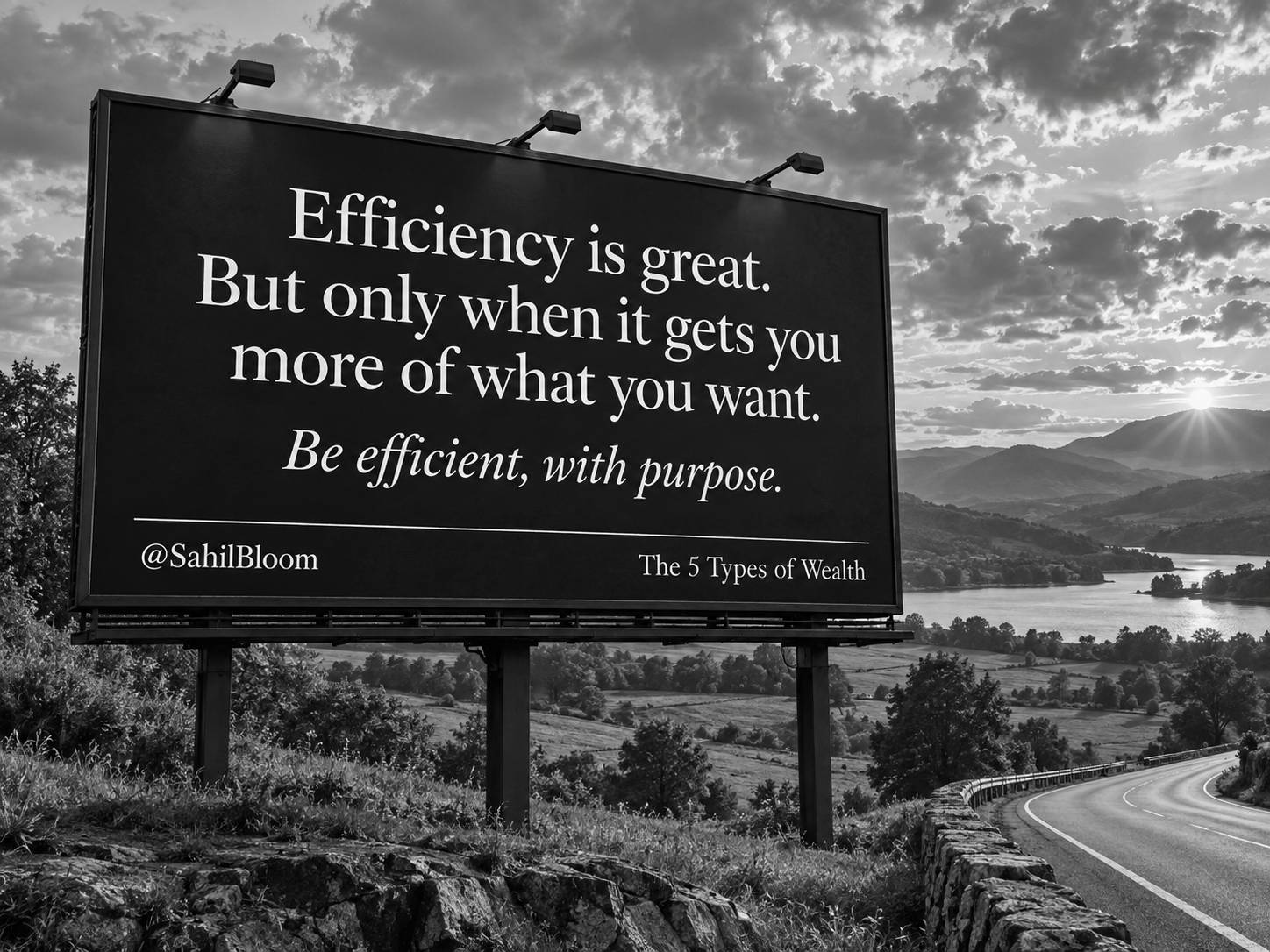
Efficiency is great. But only when it gets you more of what you want.
Be efficient, with purpose.