


9 Harsh Truths Nobody Told You About Success

Today at a Glance
What’s a Rich Text element?
The rich text element allows you to create and format headings, paragraphs, blockquotes, images, and video all in one place instead of having to add and format them individually. Just double-click and easily create content.
Static and dynamic content editing
A rich text element can be used with static or dynamic content. For static content, just drop it into any page and begin editing. For dynamic content, add a rich text field to any collection and then connect a rich text element to that field in the settings panel. !
- ml;xsml;xa
- koxsaml;xsml;xsa
- mklxsaml;xsa
How to customize formatting for each rich text
Headings, paragraphs, blockquotes, figures, images, and figure captions can all be styled after a class is added to the rich text element using the "When inside of" nested selector system.
I'm convinced that the market for telling people what they want to hear is much larger than the market for telling people what they need to hear.
That one fact explains a lot of what you see in the world.
But my goal has always been to be real. Even if it's unpopular. Because everything I write is something I hope my son reads someday, and I owe him the truth.
Today, that truth is a few things nobody told you about success.
It may not be what you want to hear. But it's definitely what you need to hear...
1. Growth often feels like destruction.
I wish somebody had told me that growth isn't always an upward journey.
Imagine a landscape with a bunch of slopes and peaks. You're standing on the tallest peak in your immediate surroundings. You can see taller peaks in the distance ahead of you, but you can't get there without walking downhill.
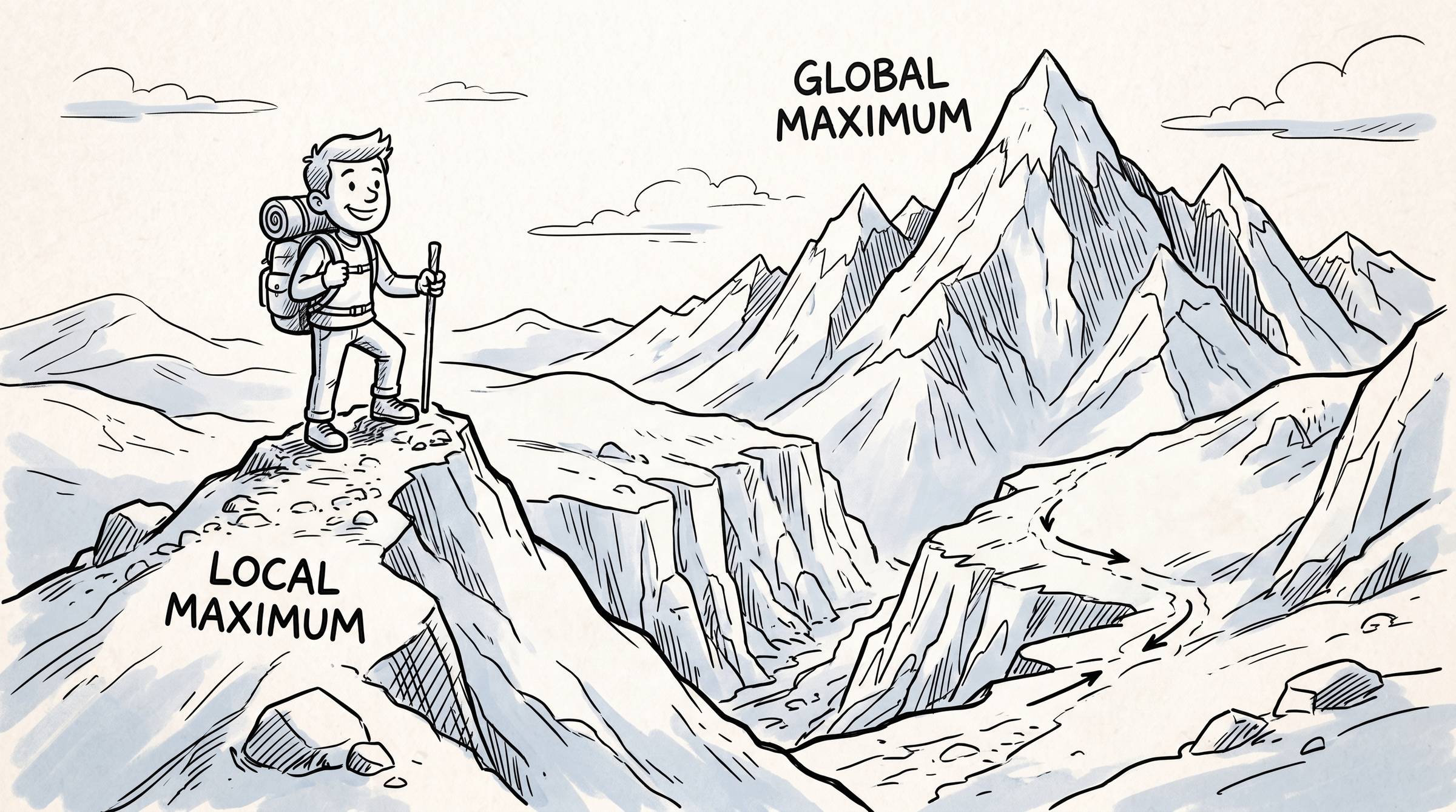
You are at a local maximum. But to reach the global maximum, you need to be willing to descend.
That's why growth often feels like destruction. Because it requires you to tear things down before they can be rebuilt to reach new heights.
It means new standards. New mindsets. New habits. New environments. New relationships. Leaving the safety and comfort of what you have to explore what you're capable of becoming.
Growth hurts more than people are willing to admit.
2. Success is a trap more powerful than failure.
Every local maximum you reach is a trap.
You've reached a new height. You're at the top of your game as you know it. You're making more money. Have more responsibility. More power.
So, you expand your life to meet those new means. You upgrade your houses, your cars, your travel, your things. You hire more, build a bigger team, outsource every inefficiency in your life. You and your family become accustomed to this life at the local maximum.
What's more, you become accustomed to your success. Your identity is tied up in your achievements. You are the type of person who has that success.
And suddenly, the local maximum becomes a prison. Because you can't possibly imagine walking down to go reach that global maximum in the distance.
Your expectations have scaled in line with your reality. You have no Margin of Freedom, the buffer between your reality and your expectations.
You're stuck in a trap. The trap of success.
To avoid this end, maintain a Margin of Freedom. Keep your lifestyle below your means. Maintain relationships that keep you grounded. Detach your identity from your output. Design space for regular play.
It's the only way to keep yourself from becoming a prisoner of your own success.

3. Success is much simpler than you think.
When I was starting out, my assumption was that achieving the mythical goal of success would require something like the continuous execution of an intellectually challenging set of tasks over an extended period of time.
Basically, I thought it was going to be really complex.
In fact, it's the opposite. Most success is achieved through the daily execution of a simple, boring set of principles that have persisted across time.
I'd probably boil it down to four things:
- Create value. Money earned is a direct byproduct of value created. What problems can you solve for the people around you? Figure them out, solve them, scale that solution. Create value, receive value. That's the real golden rule.
- Finish things. The world is full of half-written books, half-built businesses, and half-kept promises. You stand out by showing up. By closing loops. By doing what you said you’d do. By having the courage to finish.
- Be easy to work with. Show up on time. Do what you said you'd do. Bring solutions, not problems. Never create drama. Be responsive. Be emotionally consistent. Be kind. People will always want to support someone who just makes their life easier.
- Do uncomfortable things sooner. The delayed conversation gets harder. The ignored problem gets bigger. The small repair gets more expensive. Peace is never found through avoidance. It’s found through direct early action.
Honestly, the bar is shockingly low. Few people are willing to execute on the basics. So if you do those four things consistently, you'll find a way to win.
4. Success is much lonelier than you think.
The saddest thing about success is realizing how few people wanted to see you succeed in the first place.
They smiled when you got started. They celebrated some early wins. But as soon as you start breaking out of the box they placed you in, the cheering stops. It gets quiet. Because a lot of people only wanted you to succeed if it felt good for them.
And as you keep pushing forward, it can start to feel pretty lonely.
The truth is that when you start growing, changing, and developing faster than your environment, you stop fitting into it.
The people you were once aligned with start to feel distant. Almost like you no longer have a shared language of expression. They don't seem to understand your new standards or motivations. They say you've changed. They tell you to be realistic. They laugh at your ambitions.
You've outgrown the old environment, but have yet to create your new one. That's the lonely period. It's natural, a sign you're on the right path. Embrace it. Use the solitude and focus it creates to accelerate your transformation.
And remember: You are not responsible for the way your growth journey makes other people feel.
5. The hardest thing is learning how to rest.
The single greatest challenge for any ambitious person is eliminating the guilt associated with free time and rest.
It's reframing rest as a part of your performance, rather than a reward for your efforts.
Years of conditioning have convinced you that everything you want is on the other side of active effort. That any time away from that effort carries an opportunity cost in the form of lost productivity, lost output, and lost results.
That mindset is short-term beneficial and long-term destructive. It's like taking on a debt that has to be repaid with interest at a date in the future. It feels good now, but the bill eventually comes due, either in the form of burnout or unhappiness.
Don't become one of the "successful" people incapable of turning off. It's difficult, but essential to thriving over the decades.
6. Intelligence alone is never enough.
I’m convinced that intelligence is overrated.
Not irrelevant, but definitely overrated. Because in my experience, intelligent people are more likely to overthink, overplan, and overanalyze. They fear the judgment of others if they're proven wrong.
They hide behind motion that doesn't create progress. Information gathering as sport. Jammed into neat little dopamine feedback loops that convince them that they're doing something productive and valuable.
They're just one piece of information away from the big breakthrough. They'll start when their business plan is perfected. They'll get that dream job when they have one more degree in hand.
And with the rise of AI, the intelligence playing field is flattening. Intelligence is becoming abundant.
Courage is not. And it can’t be replaced.
Your entire life will change when you realize the world isn't run by a bunch of geniuses. The world is being run by a bunch of normal people with abnormal bias for action. With abnormal courage.
You get to tap yourself in whenever you want. You can just do things. Courage beats intelligence. Remember that.
7. You can't "turn off" the things that got you there.
There are a lot of "negative" traits that are surprisingly common among highly successful people during their rise.
If you read the biographies of history's most impressive men and women, you'll find a lot of common threads. Things like insecurity, stress, anxiety, and paranoia. In manageable quantities, they all seem to contribute to achievement.
Insecurity feeds action. The chip on the shoulder that drives someone. Stress and anxiety over the future can be channeled into relentless energy when the direction is clear. Paranoia avoids complacency.
The mistake is thinking that you can outgrow any of these things.
The traits that got you there don't magically go away when you achieve the success you were after. If anything, they persist or become stronger. You can learn to manage them more effectively, but they're just part of the kit.
8. No plan has ever survived first contact.
In 1880, Helmuth von Moltke the Elder, a Prussian military commander, wrote, "No plan of operations reaches with any certainty beyond the first encounter with the enemy's main force."
It's often paraphrased as simply:
No plan has ever survived first contact with the enemy.
Everything is harder and more chaotic than you think when you're making plans before the start. Because there are far more variables than you can ever account for at the outset. Far more uncertainty than you can ever imagine.
You never really figure it out when it comes to any of this. You don't get better at planning. You get better at adapting.
You increase your recovery speed. You shrink the window between failure and recovery. You master the art of the fresh start.
Adaptability always beats planning.
9. You'll never feel successful unless you create your own definition of success.
The final point is an important one, because it forces you to zoom out:
If you measure yourself on someone else's terms, you'll never be satisfied with what you see. If you make your happiness conditional, you'll never feel happy. If you define your success on the basis of comparison to others, you'll never feel successful.
The goalposts just keep moving if you let them.
"When I get X, then I'll be happy" is the worst lie you tell yourself. You'll get that thing, feel that momentary blip of dopamine-induced euphoria, and then reset to the familiar dread of needing to do more. Never doing enough.
My entire life changed when I realized that the only way to feel successful is to create your own definition of success.
To reject whatever definition the world hands you. To measure yourself on your own terms. To live by your own design.
So, what's yours? What does your success look like?


